State Profile: This Midwestern state has a mid-sized population compared with other US states, and approximately 23% are children. The state is predominantly White (non-Hispanic ~77%), but its child population is more heterogeneous, with growing Hispanic/Latino (~7%), Black (~7%), Asian (~5%), and Native American (~1%) communities. CYSHCN make up about 13%–15% of the state’s child population (~170,000–190,000 children). The majority of the CYSHCN population is insured, and almost equally divided between public and private insurance.
Refer to the full implementation guide for details.
Summary
The Community of Practice (CoP) was created to strengthen care coordination for children and youth with special health needs by connecting health, education, and family systems. It evolved from informal networking into a statewide, structured learning community with 700 care coordinators. It has led to a better understanding of policy barriers, and has worked to create sustained system change.
Exploration (2014–2015) 
Convened stakeholders as a workgroup: Department of Health (Children & Youth with Special Health Needs), Department of Education, family leaders, Family Voices, and Health Care Homes
- Goal: improve medical home performance as grant measure; identified care coordination as weakest component, connected health and education systems
- Examined data: Title V measures & National Survey of Children’s Health (NSCH)
- Used a System Support map and regional meetings with multidisciplinary partners (eg, health care, education, county services, mental health, families); each region created maps and impact matrices to identify needs and priorities
- Informal CoP started evolving from regional meetings
- Key finding: families faced multiple coordinators → need for formal CoP
Installation (2016–2018) 
- Formed steering group; launched CoP concept at Health Care Homes Learning Days
- 86% of attendees wanted ongoing participation; preferred annual in-person meetings and webinars
- Leveraged existing structures: Health Care Homes’ learning collaboratives, conferences, and training modules for initial pilot
Initial Implementation (2018–2020) 
- Piloted clinic-based QI projects which had short-term gains in training at single site, but lacked sustainability or reach outside of clinical site; ended during COVID
- Informal CoP solidified into formal network; Title V hosted early webinars
- Staffing: assigned project lead; issued an RFP and hired facilitation contractor (2020)
Full Implementation (2020–2024) 
- Created logic model with outcomes for CoP facilitator; hired facilitator for CoP
- Scaled to ~700 care coordinators statewide
- Sustained CoP for 5–7 years; later shifted facilitation in-house (2024)
- Developed new online platform; focused on shared measures and intentional content
- Current priorities: reimbursement reform, Medicaid payment codes, HIPAA/FERPA alignment, improved processes for families and coordinators
- Planning for broader system-level change: build policymaker team, strengthen interagency relationships
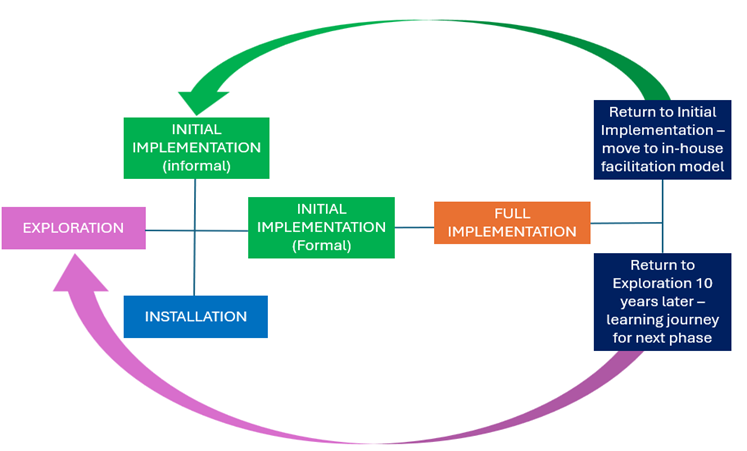
Implementation Framework is Not Linear
- The informal CoP organically began during the exploration phase, while formal structures were designed in the installation phase
- Returned to initial implementation after decision to move to in-house facilitation
- Returned to exploration for next phase of the systems innovation
Impact
The Pediatric Care Coordination Community of Practice (CoP) program significantly strengthened the state’s care coordination system by fostering broad collaboration among health, education, family, and community stakeholders. It evolved from informal networks into a formal statewide structure, engaging nearly 700 care coordinators and leveraging existing resources to reduce costs and accelerate adoption. Data-driven tools and performance measures guided improvements, while sustainability was ensured by braided funding streams, adapted staff roles, and strategic internal facilitation. The CoP laid the groundwork for future system-level change through intentional design and common measures.
Lessons Learned
- Broad stakeholder engagement is essential. Bringing together health, education, families, and community services created shared ownership and revealed system gaps.
- Data and evidence are catalysts. Performance measures guided priorities, and the System Support Map helped visualize roles, duplication, and needs across regions, making the case for system solutions.
- Allow the program to expand. Leverage existing infrastructure to build on what already exists, and adapt existing positions to expand scope of pre-existing staff roles.
- Organic growth builds momentum. Regional meetings not only assessed systems but also built organic connections that seeded the community of practice.
- Use multiple funding streams. Combining Title V, Part B interagency agreements, and state funds enabled flexibility and resilience, with braided funding.
- Unsuccessful pilots highlight the need for CoP. Clinic-based quality improvement projects showed short-term gains but lacked sustainability and spread once funding ended.
- The impacts of contracting are distinct from those of internal facilitation. Outsourcing facilitation helped scale quickly, but shifting to internal facilitation later proved more sustainable, allowing for shared measures, intentionality in learning opportunities, and a different online communication format.
Last Updated
03/10/2026
Source
American Academy of Pediatrics