Below you'll find practical strategies for how to counsel families on appropriate types and levels of activity.
FEATURED RESOURCE
Resistance Training in Youth: Myth vs. Fact
Resistance training, done properly, can provide many health benefits even in children and adolescents. However, there remain many misconceptions about the downsides in youth. Learn more about the myths and facts of resistance training in youth.
Activity Intensity
What is it?
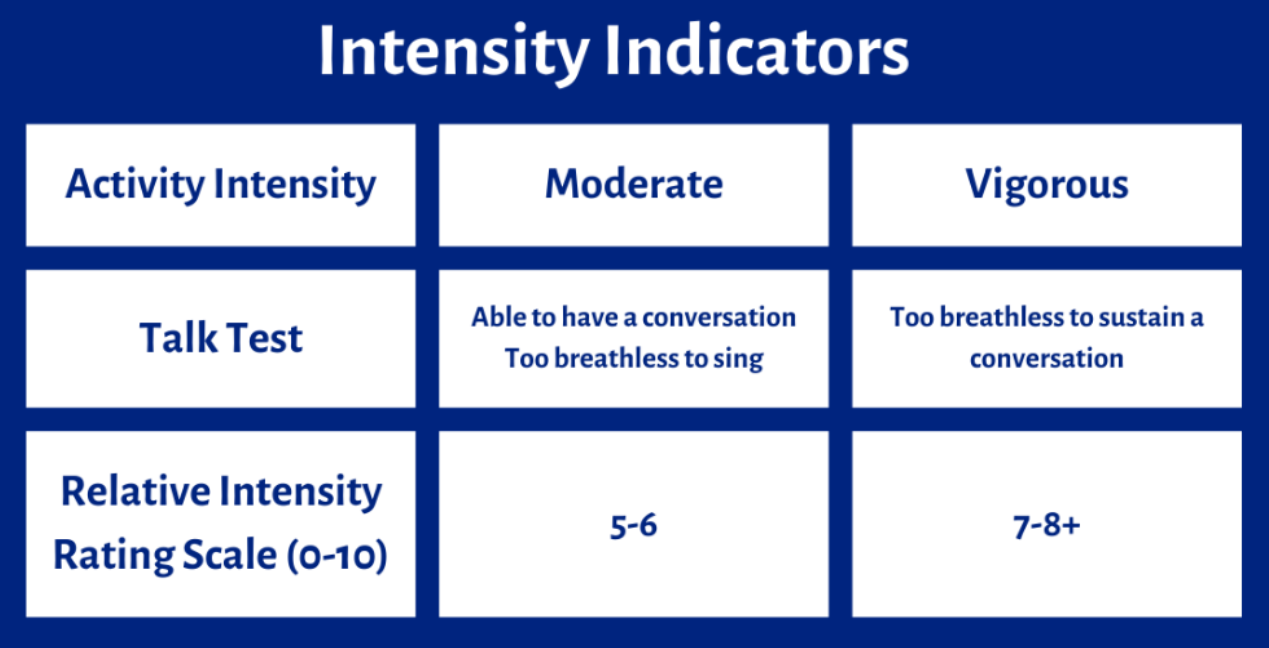
Activity intensity refers to how hard a person works during an activity. Current activity recommendations for children and adolescents focus on moderate and vigorous intensity levels.
- During moderate activity, participants can hold a conversation but are too out of breath to sing.
- During vigorous activity, participants are too out of breath to have a conversation.
Why is it important?
Intensity is one of the factors that determines the benefits of physical activity.
Recent evidence indicates that vigorous activity is particularly beneficial for this age group, especially in relation to metabolism and cardiovascular risk.
How much and how often?
The World Health Organization currently recommends that children and adolescents participate in an average of 60 minutes of moderate to vigorous activity per day, and including bouts of vigorous-intensity activities at least three days a week. Although there are no formal recommendations for vigorous activity duration, cardiovascular risk appears to be minimized in children participating in bouts of about 20 minutes in duration.
Bone Strengthening Activity
What is it?
Activity that increases impact on the bone or increases tension where the muscles attach the bone.
Examples:
- Running, jumping, tumbling
- Activities that involve pushing or pulling, such as weight training
There is a lot of overlap between bone strengthening, muscle strengthening and cardiovascular activity.
Many sports and activities that kids like to do include all of these!
Why is it important?
Most bone mass and density is gained during childhood and adolescence, with 30-40% of this gained in the years surrounding peak height velocity. Optimizing gains in bone mass through healthy activity and nutrition can reduce risk for injury and protects against future development of osteoporosis.
How much and how often?
Current recommendations for children and adolescents: muscle building activity at least 3 days per week as part of 60 minutes of recommended daily activity.
Muscle Strengthening Activity
What is it?
Activity using muscles to work against an applied force or weight. These often include pushing or pulling against resistance.
Examples:
- Resistance training with weights, bands, or body weight.
- Climbing trees and rocks, swimming, and many playground activities
Children who are overweight or obese often find strength training more enjoyable than other activities.
Why is it important?
Building muscle strength enhances daily function and capacity for healthy levels of physical activity and sport, improves metabolic rate and can reduce cardiovascular risk.
Strength building is specific to the muscles used for the activity. It is important to include a variety of activities to use all the major muscle groups in the body.
How much and how often?
Current recommendations are for children and adolescents to perform muscle building activity on at least 3 days per week as part of their 60 minutes of recommended daily activity.
Last Updated
07/22/2026
Source
American Academy of Pediatrics