The AAP Simulation Program is committed to advancing pediatric patient care through dynamic, evidence-based approaches. From immersive simulation experiences to creative learning strategies, we design programs that empower professionals to deliver exceptional care.
Exciting opportunities are always on the horizon—check back often to discover new ways to learn, connect, and grow with us!
Clinical Event Debriefing Program
The American Academy of Pediatrics Clinical Event Debriefing (CED) Program, a 12-month Quality Improvement (QI) project, is designed to enhance patient care and team performance. Successful completion will equip healthcare professionals and organizations in the ambulatory and hospital-based settings with framework and techniques to conduct meaningful and effective debriefings after clinical events.
Whether you are new to the field or a seasoned healthcare leader, the CED program offers invaluable opportunities to grow professionally and positively impact patient outcomes.
Stay tuned-- open application period coming soon!
Simulation Disaster Day
An EMS Disaster Readiness Day for Educators was held at the American Academy of Pediatrics Headquarters! This interactive, simulation-based workshop was designed specifically for EMS educators who wanted to enhance pediatric disaster readiness.
Participants:
- Explored critical elements of effective pediatric mass casualty simulations, including scenario design, fidelity, and engagement strategies.
- Collaboratively designed comprehensive, evidence-based simulation scenarios aligned with PEPP guidelines, featuring standardized patient roles and precise learner assessment tools.
- Mastered facilitation skills using the PEARLS debriefing model to promote deep reflection, critical thinking, and practical knowledge application among learners.
- Evaluated and refined instructional strategies by analyzing feedback and assessment data to continuously improve learner outcomes.
Bodyswaps Equity & Anti-Racism in Global Healthcare
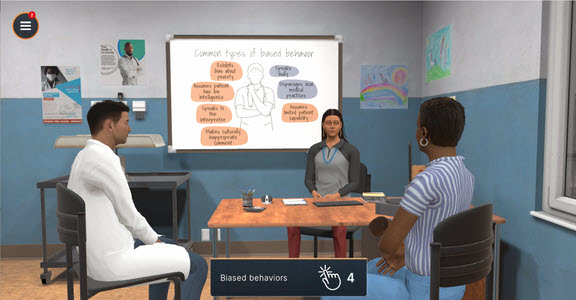 Introducing a new virtual reality training module, designed to provide a psychologically safe space where healthcare professionals can explore their own implicit biases and motivations before embarking on global health experiences.
Language barriers can elicit bias through tone, body language, and social cues and lead to ineffective, non-empathetic communication. These biases have been shown to lead to disparities in treatment (e.g., pain assessment and analgesia), healthcare accessibility (highlighting value of a strong patient-provider relationship) and health outcomes (e.g., increased odds of an adverseoutcome in hospitalized patients).
Although everyone has implicit biases, through education and awareness these biases can be addressed and mitigated. This activity is designed to change competence and performance by demonstrating the impact of bias on patient outcomes, practicing strategies to mitigate personal bias and navigating difficult but important conversations about bias.
Learning Objectives: After completing this course, you should be able to
- Recognize the impact of bias on patient outcomes and practice strategies to mitigate bias
- Employ mitigation strategies, and practice navigating difficult conversations
AAP programs that utilize simulation
Last Updated
12/15/2025
Source
American Academy of Pediatrics