Congenital syphilis (CS) is a severe, preventable condition caused by transplacental transmission of Treponema pallidum from a pregnant woman with syphilis infection to a fetus. Early diagnosis and appropriate treatment are critical to prevent complications such as stillbirth, prematurity, neonatal death, and long-term disability. Congenital syphilis may be contracted at any stage of pregnancy, or via contact with lesions at the time of delivery.

This interactive clinical reference is designed to support healthcare providers in delivering timely, evidence-based care for infants at risk for or diagnosed with congenital syphilis. It offers concise, easy-to-navigate guidance on evaluation, treatment, and follow-up, aligned with the most current national recommendations. Whether used at the bedside, during rounds, or as part of care planning, this tool serves as a quick reference to assist with clinical decision-making, streamline workflows, and promote best practices in neonatal care.

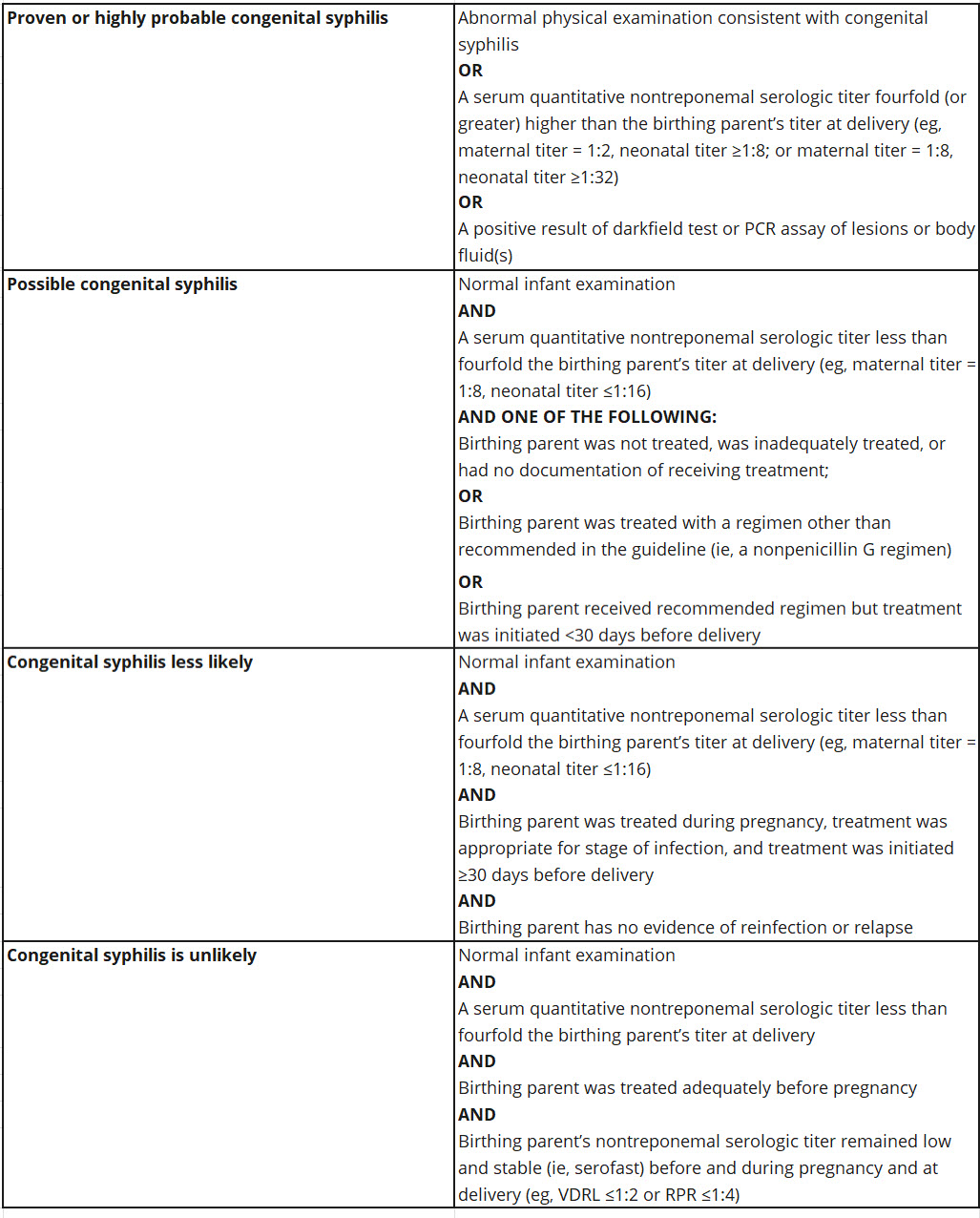
Please use the algorithm or table below to determine which evaluation and management path to follow.

Evaluation and Treatment of Infants Up To 1 Month of Age With Possible, Probable, or Confirmed Congenital Syphilis (Adapted from 2024 Red Book Table 3.72)

Algorithm

Choose One
Choose One

Proven or Highly Probable Congenital Syphilis

Evaluation:

  • CSF analysis (CSF VDRL, cell count, protein)
  • CBC with differential and platelet count
  • Long-bone radiography
  • Other tests as clinically indicated: Chest radiography, aminotransferases, neuroimaging, ophthalmologic examination, auditory brain stem response, HIV testing

Treatment:

  • Aqueous crystalline penicillin G, 50 000 U/kg, IV, every 12 hours (1 wk or younger), then every 8 h for infants older than 1 wk, for a total of 10 days of therapy (preferred). If 24 hrs or more of therapy is missed, the entire course must be restarted.
    OR
  • Penicillin G procaine, 50 000 U/kg, IM, as single daily dose for 10 days 

Key Takeaways

  • Prevention is Key: Maternal screening and treatment during pregnancy are essential. Siblings of infants with congenital syphilis may require screening.
  • Follow-Up is Critical: Ensure adherence to testing schedules and monitor for late manifestations.
  • Collaboration: Work with public health, families, and specialists to optimize outcomes.

For more information, consult the AAP Red Book (2024) or your local public health department.

Proven or Highly Probable Congenital Syphilis

Evaluation:

  • CSF analysis (CSF VDRL, cell count, protein)
  • CBC with differential and platelet count
  • Long-bone radiography
  • Other tests as clinically indicated: Chest radiography, aminotransferases, neuroimaging, ophthalmologic examination, auditory brain stem response, HIV testing

Treatment:

  • Aqueous crystalline penicillin G, 50 000 U/kg, IV, every 12 hours (1 wk or younger), then every 8 h for infants older than 1 wk, for a total of 10 days of therapy (preferred). If 24 hrs or more of therapy is missed, the entire course must be restarted.
    OR
  • Penicillin G procaine, 50 000 U/kg, IM, as single daily dose for 10 days 

Key Takeaways

  • Prevention is Key: Maternal screening and treatment during pregnancy are essential. Siblings of infants with congenital syphilis may require screening.
  • Follow-Up is Critical: Ensure adherence to testing schedules and monitor for late manifestations.
  • Collaboration: Work with public health, families, and specialists to optimize outcomes.

For more information, consult the AAP Red Book (2024) or your local public health department.

Possible Congenital Syphilis

Evaluation:

  • CSF analysis (CSF VDRL, cell count, protein)
  • CBC with differential and platelet count
  • Long-bone radiography
  • This evaluation is not necessary if a 10-day course of parenteral therapy is administered, although such evaluations might be useful.

Treatment:

  • Aqueous crystalline penicillin G, 50 000 U/kg, IV, every 12 hours (1 wk or younger), then every 8 h for infants older than 1 wk, for a total of 10 days of therapy (preferred). If 24 hrs or more of therapy is missed, the entire course must be restarted.
    OR
  • Penicillin G procaine, 50 000 U/kg, IM, as single daily dose for 10 days
    OR
  • Penicillin G benzathine, 50 000 U/ kg, IM, single dose (recommended by some experts, but only if all components of the evaluation are obtained and are normal and follow- up is certain). If CSF is not obtained or is uninterpretable (eg, bloody tap), a 10-day course is recommended.

Key Takeaways

  • Prevention is Key: Maternal screening and treatment during pregnancy are essential. Siblings of infants with congenital syphilis may require screening.
  • Follow-Up is Critical: Ensure adherence to testing schedules and monitor for late manifestations.
  • Collaboration: Work with public health, families, and specialists to optimize outcomes.

For more information, consult the AAP Red Book (2024) or your local public health department.

Possible Congenital Syphilis

Evaluation:

  • CSF analysis (CSF VDRL, cell count, protein)
  • CBC with differential and platelet count
  • Long-bone radiography
  • This evaluation is not necessary if a 10-day course of parenteral therapy is administered, although such evaluations might be useful.

Treatment:

  • Aqueous crystalline penicillin G, 50 000 U/kg, IV, every 12 hours (1 wk or younger), then every 8 h for infants older than 1 wk, for a total of 10 days of therapy (preferred). If 24 hrs or more of therapy is missed, the entire course must be restarted.
    OR
  • Penicillin G procaine, 50 000 U/kg, IM, as single daily dose for 10 days
    OR
  • Penicillin G benzathine, 50 000 U/ kg, IM, single dose (recommended by some experts, but only if all components of the evaluation are obtained and are normal and follow- up is certain). If CSF is not obtained or is uninterpretable (eg, bloody tap), a 10-day course is recommended.

Key Takeaways

  • Prevention is Key: Maternal screening and treatment during pregnancy are essential. Siblings of infants with congenital syphilis may require screening.
  • Follow-Up is Critical: Ensure adherence to testing schedules and monitor for late manifestations.
  • Collaboration: Work with public health, families, and specialists to optimize outcomes.

For more information, consult the AAP Red Book (2024) or your local public health department.

Congenital Syphilis Less Likely

Evaluation:

  • Not recommended

Treatment:

  • Penicillin G procaine, 50 000 U/kg, IM, single dose (preferred)
  • Alternatively, infants whose birthing parent’s nontreponemal titers decreased at least fourfold after appropriate therapy for early syphilis or remained stable at low titer (eg, VDRL ≤1:2; RPR ≤1:4) may be followed every 2–3 mo without treatment until the nontreponemal test becomes nonreactive. See Red Book for details of monitoring.

Key Takeaways

  • Prevention is Key: Maternal screening and treatment during pregnancy are essential. Siblings of infants with congenital syphilis may require screening.
  • Follow-Up is Critical: Ensure adherence to testing schedules and monitor for late manifestations.
  • Collaboration: Work with public health, families, and specialists to optimize outcomes.

For more information, consult the AAP Red Book (2024) or your local public health department.

Congenital Syphilis Less Likely

Evaluation:

  • Not recommended

Treatment:

  • Penicillin G procaine, 50 000 U/kg, IM, single dose (preferred)
  • Alternatively, infants whose birthing parent’s nontreponemal titers decreased at least fourfold after appropriate therapy for early syphilis or remained stable at low titer (eg, VDRL ≤1:2; RPR ≤1:4) may be followed every 2–3 mo without treatment until the nontreponemal test becomes nonreactive. See Red Book for details of monitoring.

Key Takeaways

  • Prevention is Key: Maternal screening and treatment during pregnancy are essential. Siblings of infants with congenital syphilis may require screening.
  • Follow-Up is Critical: Ensure adherence to testing schedules and monitor for late manifestations.
  • Collaboration: Work with public health, families, and specialists to optimize outcomes.

For more information, consult the AAP Red Book (2024) or your local public health department.

Congenital Syphilis Less Likely

Evaluation:

  • Not recommended

Treatment:

  • None, but infants with reactive nontreponemal tests should be followed serologically to ensure test result returns to negative
  • Penicillin G procaine, 50 000 U/kg, IM, single dose can be considered if follow-up is uncertain, and infant has a reactive test (some experts)
  • Neonates with a negative nontreponemal test result at birth and whose birthing parent was seroreactivity at delivery should be retested at 3 mo to rule out incubating congenital syphilis. See Red Book for details of monitoring.

Key Takeaways

  • Prevention is Key: Maternal screening and treatment during pregnancy are essential. Siblings of infants with congenital syphilis may require screening.
  • Follow-Up is Critical: Ensure adherence to testing schedules and monitor for late manifestations.
  • Collaboration: Work with public health, families, and specialists to optimize outcomes.

For more information, consult the AAP Red Book (2024) or your local public health department.

Congenital Syphilis Less Likely

Evaluation:

  • Not recommended

Treatment:

  • None, but infants with reactive nontreponemal tests should be followed serologically to ensure test result returns to negative
  • Penicillin G procaine, 50 000 U/kg, IM, single dose can be considered if follow-up is uncertain, and infant has a reactive test (some experts)
  • Neonates with a negative nontreponemal test result at birth and whose birthing parent was seroreactivity at delivery should be retested at 3 mo to rule out incubating congenital syphilis. See Red Book for details of monitoring.

Key Takeaways

  • Prevention is Key: Maternal screening and treatment during pregnancy are essential. Siblings of infants with congenital syphilis may require screening.
  • Follow-Up is Critical: Ensure adherence to testing schedules and monitor for late manifestations.
  • Collaboration: Work with public health, families, and specialists to optimize outcomes.

For more information, consult the AAP Red Book (2024) or your local public health department.

Infants ≥1 Month of Age and Children (See Red Book for additional details; note differences in penicillin dosing)

Evaluation

For the infant or child identified as having reactive serologic tests for syphilis, the birthing parent’s serologic test results and records should be reviewed to assess whether the infant or child has congenital or acquired syphilis.

Evaluation for congenital syphilis after 1 month of age includes:

  1. CSF analysis for VDRL, cell count, and protein
  2. complete blood cell count with differential and platelet count
  3. if clinically indicated, long-bone radiographs, chest radiograph, liver function tests, ophthalmologic examination, neuroimaging, and auditory brain-stem response)
  4. testing for HIV infection.

Treatment

  1. Standard Intravenous Therapy:
    • Medication: Aqueous crystalline penicillin G.
    • Dosage: 200,000–300,000 U/kg/day intravenously.
    • Administration: 50,000 U/kg per dose, every 4–6 hours, for 10 days.
  2. Optional Additional IM Therapy:
    • After the 10-day IV course, some experts recommend a single dose of penicillin G benzathine (50,000 U/kg IM, not to exceed 2.4 million U).
  3. Alternative IM Therapy for Select Cases:
    • If the patient has no clinical manifestations, a normal CSF examination, and a negative CSF-VDRL test result, some experts suggest:
      • Penicillin G benzathine: 50,000 U/kg IM once weekly for 3 weeks (not to exceed 2.4 million U per dose).
  4. Follow-Up Testing:
    • Serologic response should show a fourfold decline in titers over time. Persistent or rising titers necessitate further evaluation.
Infants ≥1 Month of Age and Children (See Red Book for additional details; note differences in penicillin dosing)

Evaluation

For the infant or child identified as having reactive serologic tests for syphilis, the birthing parent’s serologic test results and records should be reviewed to assess whether the infant or child has congenital or acquired syphilis.

Evaluation for congenital syphilis after 1 month of age includes:

  1. CSF analysis for VDRL, cell count, and protein
  2. complete blood cell count with differential and platelet count
  3. if clinically indicated, long-bone radiographs, chest radiograph, liver function tests, ophthalmologic examination, neuroimaging, and auditory brain-stem response)
  4. testing for HIV infection.

Treatment

  1. Standard Intravenous Therapy:
    • Medication: Aqueous crystalline penicillin G.
    • Dosage: 200,000–300,000 U/kg/day intravenously.
    • Administration: 50,000 U/kg per dose, every 4–6 hours, for 10 days.
  2. Optional Additional IM Therapy:
    • After the 10-day IV course, some experts recommend a single dose of penicillin G benzathine (50,000 U/kg IM, not to exceed 2.4 million U).
  3. Alternative IM Therapy for Select Cases:
    • If the patient has no clinical manifestations, a normal CSF examination, and a negative CSF-VDRL test result, some experts suggest:
      • Penicillin G benzathine: 50,000 U/kg IM once weekly for 3 weeks (not to exceed 2.4 million U per dose).
  4. Follow-Up Testing:
    • Serologic response should show a fourfold decline in titers over time. Persistent or rising titers necessitate further evaluation.

Outpatient Management of Infants with Possible, Probable, or Confirmed Congenital Syphilis

  1. Serologic Testing and Monitoring:
    • All infants who have reactive serologic tests for syphilis or were born to a person who was seroreactivity at delivery should receive careful follow-up evaluations during well-child care visits at 2, 4, 6, and 12 months of age. 
    • Serologic nontreponemal tests should be performed every 2 to 3 months until the test becomes nonreactive. Nontreponemal antibody titers typically decrease by 3 months of age and should be nonreactive by 6 months of age, whether the infant was infected and adequately treated or was not infected and initially seropositive because of transplacentally acquired maternal antibody.
    • The serologic response after therapy may be slower for infants treated after the neonatal period. Patients with increasing titers or with persistent stable titers 6 to 12 months after initial treatment should be reevaluated, including a CSF examination. Retreatment with a 10-day course of parenteral penicillin G may be indicated, even if they were treated previously.
  2. Neurologic Monitoring:
    • Neonates whose initial CSF evaluations are abnormal do not need repeat lumbar puncture unless they exhibit persistent nontreponemal serologic test titers at age 6 to 12 months. After 2 years of follow-up, a reactive CSF VDRL test or abnormal CSF indices that cannot be attributed to another ongoing illness at the 6-month interval are indications for retreatment.
  3. Hearing and Vision Screening:
    • Periodic audiologic evaluations (eg, at birth, 6 months, and 12 months).
    • Periodic vision screening for interstitial keratitis and other late-stage manifestations.
  4. Developmental and Growth Monitoring:
    • Assess milestones at well-child visits and evaluate for signs of late CS, such as Hutchinson teeth or bone deformities.
  5. Parental Education:
    • Reinforce adherence to follow-up appointments and educate on recognizing late complications, such as hearing loss or neurologic symptoms.
  6. Public Health Coordination:
    • Ensure reporting of cases and follow-up care for maternal and household contacts.
  7. Late-Stage Management:
    • If late manifestations (eg, skeletal abnormalities, neurologic deficits) arise, refer to appropriate specialist providers (eg, infectious diseases, neurology, audiology, orthopedics).

Outpatient Management of Infants with Possible, Probable, or Confirmed Congenital Syphilis

  1. Serologic Testing and Monitoring:
    • All infants who have reactive serologic tests for syphilis or were born to a person who was seroreactivity at delivery should receive careful follow-up evaluations during well-child care visits at 2, 4, 6, and 12 months of age. 
    • Serologic nontreponemal tests should be performed every 2 to 3 months until the test becomes nonreactive. Nontreponemal antibody titers typically decrease by 3 months of age and should be nonreactive by 6 months of age, whether the infant was infected and adequately treated or was not infected and initially seropositive because of transplacentally acquired maternal antibody.
    • The serologic response after therapy may be slower for infants treated after the neonatal period. Patients with increasing titers or with persistent stable titers 6 to 12 months after initial treatment should be reevaluated, including a CSF examination. Retreatment with a 10-day course of parenteral penicillin G may be indicated, even if they were treated previously.
  2. Neurologic Monitoring:
    • Neonates whose initial CSF evaluations are abnormal do not need repeat lumbar puncture unless they exhibit persistent nontreponemal serologic test titers at age 6 to 12 months. After 2 years of follow-up, a reactive CSF VDRL test or abnormal CSF indices that cannot be attributed to another ongoing illness at the 6-month interval are indications for retreatment.
  3. Hearing and Vision Screening:
    • Periodic audiologic evaluations (eg, at birth, 6 months, and 12 months).
    • Periodic vision screening for interstitial keratitis and other late-stage manifestations.
  4. Developmental and Growth Monitoring:
    • Assess milestones at well-child visits and evaluate for signs of late CS, such as Hutchinson teeth or bone deformities.
  5. Parental Education:
    • Reinforce adherence to follow-up appointments and educate on recognizing late complications, such as hearing loss or neurologic symptoms.
  6. Public Health Coordination:
    • Ensure reporting of cases and follow-up care for maternal and household contacts.
  7. Late-Stage Management:
    • If late manifestations (eg, skeletal abnormalities, neurologic deficits) arise, refer to appropriate specialist providers (eg, infectious diseases, neurology, audiology, orthopedics).
Last Updated

07/08/2025

Source

American Academy of Pediatrics