The new budget and tax law (Public Law 119-21, known as the One Big Beautiful Bill Act (OBBBA)) includes a universal mandate for each State to implement new work requirements for certain Medicaid enrollees. If enrollees are unable to meet these requirements, their individual Medicaid coverage will end. The law calls for States to implement the work requirements by January 2027, although they can do so earlier if they choose to do so.
Relevance to Title V Programs and Family Leadership Organizations
Many families/caregivers of children with disabilities have questions about how these new work requirements may impact them. Title V programs and family leadership organizations that provide benefits counseling to families, as well as those that are working collaboratively with their State's Medicaid program, will benefit from understanding more about the new work requirements, especially caregiver exemptions.
How to Identify Caregiver Exemption Eligibility
Below is a flowchart to help readers understand who the new work requirements apply to and who may be eligible for a caregiver exemption. This flowchart is designed to support Title V CYSHCN programs and family leadership organizations that work collaboratively with their state’s Medicaid program in understanding who the new work requirements apply to and who may be eligible for a caregiver exemption.
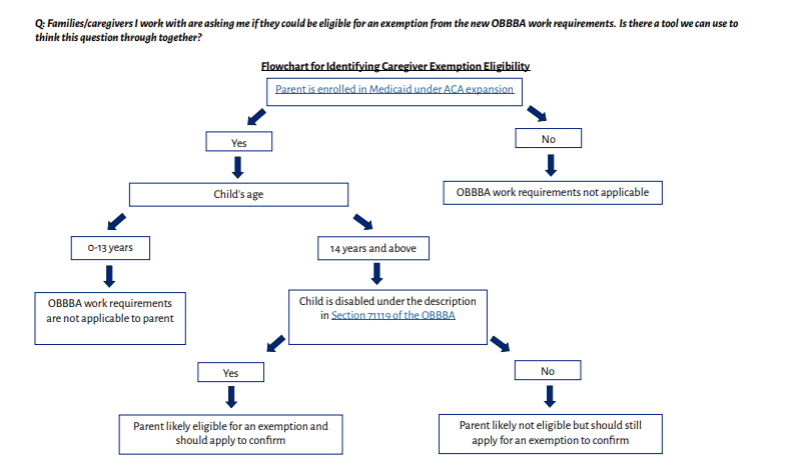
Flowchart for Identifying Caregiver Exemption Eligibility
Funding Acknowledgement
The National Center for a System of Services for CYSHCN is supported by the Health Resources and Services Administration (HRSA) of the U.S. Department of Health and Human Services (HHS) as part of an award totaling $1,500,000 with no funding from nongovernmental sources. The information or content are those of the author(s) and do not necessarily represent the official views of, nor an endorsement, by HRSA, HHS or the U.S. Government.
Last Updated
03/17/2026
Source
American Academy of Pediatrics