Internet Explorer Alert

It appears you are using Internet Explorer as your web browser. Please note, Internet Explorer is no longer up-to-date and can cause problems in how this website functions
This site functions best using the latest versions of any of the following browsers: Edge, Firefox, Chrome, Opera, or Safari.
You can find the latest versions of these browsers at https://browsehappy.com

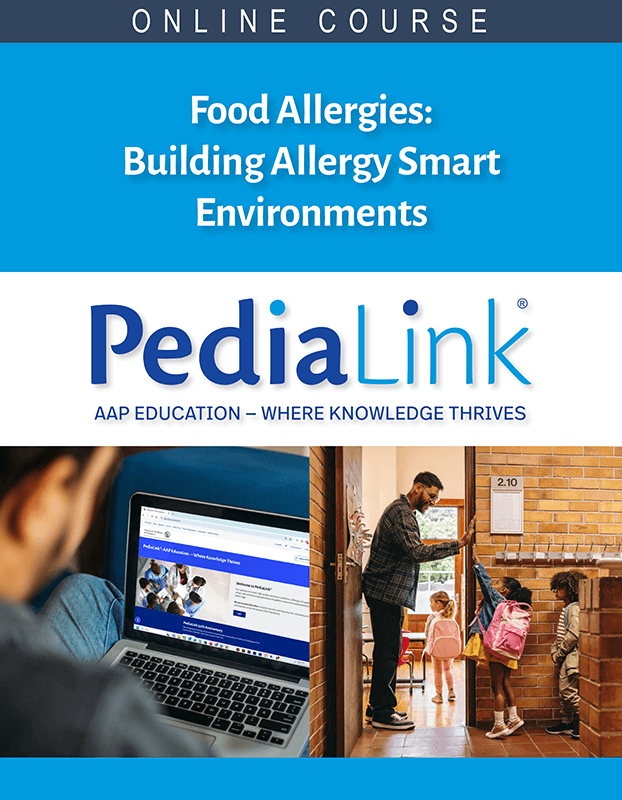
Food Allergies: Building Allergy Smart Environments

Available: 08/05/2025-08/04/2028

Format

Price: $5.00
Member Price: $5.00

Description

A food allergy is a serious and potentially life-threatening medical condition and commonly experienced amongst children. In fact, 1 in 13 children have food allergies and over 60% of food allergy reactions that occur at school take place in early care and education settings. Because of this, it is critically important that early care and education providers implement strategies to prevent exposure to food allergens and understand how to identify and treat a serious food allergic reaction. 


Targeted Audience


This course is designed for early care and education providers and staff who play a critical role in ensuring the safety and well-being of young children with food allergies.


This course consists of 3 modules focusing on best practices for maintaining a safe care environment, recognizing and managing food allergies, and responding to allergic reactions. 


Upon completion of this course, you will be able to:


  • Classify what a food allergy is and how it differs from a food intolerance.
  • Identify common food allergens.
  • Recognize the importance of allergen avoidance for the prevention of allergic reactions for children at your early care and education center.
  • Understand the steps to ensure your team is trained and educated on food allergies.
  • Identify prevention strategies and food allergy policies to implement in your early child care and education setting.
  • Create a safe cooking and food preparation environment.
  • Identify what a mild and severe food allergy reaction looks like.
  • Understand anaphylaxis and how to administer epinephrine.
  • Recognize the important role an Allergy and Anaphylaxis Emergency Plan plays.

Course Details

  • Start Date: August 5, 2025
  • Online Access Expires: August 4, 2028
  • Credit Expires: August 4, 2028
  • Course ID: 62102

Acknowledgements

​​​This module was supported in part through a grant provided by the Caplan Foundation for Early Childhood.

Faculty

Subject Matter Experts

  • Stephanie Kubala, MD, FAAP
  • Susan Laubach, MD, FAAP
  • Marissa A. Love, MD, FAAP, FAAAAI, FACAAI

Reviewers

  • Andrew N. Hashikawa, MD, MS, FAAP
  • Stephanie Leeds, MD, MHS


AAP Member Registration Fee: $5

Non-Member Registration Fee: $5

  • Other

  • Contact Hour

    1.00

Physician - Food Allergies: Building Allergy Smart Environments

The American Academy of Pediatrics (AAP) is accredited by the Accreditation Council for Continuing Medical Education (ACCME) to provide continuing medical education for physicians.

This activity is acceptable for a maximum of 0.00 AAP credits. These credits can be applied toward the AAP CME/CPD Award available to Fellows and Candidate Members of the AAP.

This activity is approved for 0.00 points of MOC Part 2 credit by the American Board of Pediatrics through the AAP MOC Portfolio Program.  All approved activities must be completed by the MOC Credit Approval End Date. All deadlines and MOC point values should be confirmed by checking the ABP Activity Catalog within each physician’s ABP Portfolio. Consult your ABP portfolio at www.abp.org for details about your specific certification requirements. For questions about how to access this activity, contact [email protected].


Allied Health Professional - Food Allergies: Building Allergy Smart Environments

The American Academy of Pediatrics (AAP) is accredited by the Accreditation Council for Continuing Medical Education (ACCME) to provide continuing medical education for physicians.

PAs may claim a maximum of 0.00 Category 1 credits for completing this activity. NCCPA accepts AMA PRA Category 1 Credit™ from organizations accredited by ACCME or a recognized state medical society.

This program is accredited for 0.00 NAPNAP CE contact hours of which 0.00 contain pharmacology (Rx) content, (0.00 related to psychopharmacology) (0.00 related to controlled substances), per the National Association of Pediatric Nurse Practitioners (NAPNAP) Continuing Education Guidelines. The AAP is designated as Agency #A17. Upon completion of the program, each participant desiring NAPNAP contact hours must send a completed certificate of attendance to [email protected]. Payment of $15 for NAPNAP members and nonmembers is required via credit card for all NAPNAP contact hour requests. Keep this certificate for your records for six (6) years. Requests for duplicate certificates should be made to the AAP.

Recommended Browsers:

  • Microsoft Edge
  • Google Chrome
  • Firefox 2.0 and above
  • Opera 7.5 and above
  • Safari 1.3.2 and above

Recommended Browser Settings:

  • JavaScript enabled
  • Cookie enabled
  • SSL 2.0 & 3.0 enabled
  • Adobe Reader Plug-in (version 6.0+)

Food Allergies: Building Allergy Smart Environments

Price:: 5.00

Feedback Form