State Profile: This Southeastern state has a large and highly heterogeneous population, with about 28.7% identifying as Hispanic or Latino, 16.9% as Black or African American, and the majority identifying as White. It also has one of the highest proportions of older adults in the country, with 21.8% aged 65 years and over, while nearly 19% are younger than age 18, reflecting both retirement migration and family growth. The state mirrors the national prevalence of 1 in 5 children (ages 0-17 years) identified as CYSHCN. The CYSHCN population demographic metrics align with those of the overall state population, and a higher percentage use public insurance than the national average.
Refer to the full implementation guide for details.
Summary
The Pediatric Behavioral Health Collaborative is a statewide initiative to integrate children’s behavioral health into primary care and break down silos between medical and mental health systems. It evolved from a small pilot project funded by Title V, which leveraged existing stakeholder infrastructure and thereby attracted additional universities and organizations, creating a snowball effect of expansion. Over time, the initiative scaled to eight regional hubs statewide.
Exploration (2017 – 2018) 
- Conducted statewide systems assessment on care coordination with a wide range of stakeholders, including statewide and regional partners, and identified behavioral health access as priority
- Benchmarking: reviewed national/state evidence and researched behavioral health innovations; applied strengths-based (SOAR) approach to examine existing resources
- Developed aim statement and logic model with support and coaching from the National MCH Workforce Development Center.
Installation (2016 – 2018) 
- Formed implementation work group: Title V consultants, physician champion, Medicaid representative, family leaders, Department of Children and Families representative
- Launched behavioral health navigator pilot funded by Title V, which generated interest and expansion from other potential partners
- Key challenges: aligning definitions, reconciling tools, and building consensus
- Started second pilot, using revisions from lessons learned in first pilot (eg, additional training in behavioral health integration)
- Began initial data collection. Embedded feedback loops for continuous improvement and trust-building; learned that future hubs needed to combine key services in first two initial pilots
- Applied for grants to scale innovation
Initial Implementation (2018 – 2020) 
- Piloted behavioral health hub regional model; scaled from individual hub sites
- Expanded team (eg, family partners, specialists, consultants, Managed Medical Assistance (MMA) plan representatives, behavioral health organizations, representatives from all hubs)
- Formalized quality improvement efforts with support from external consultant; embedded PDSA cycles into contracts, had monthly QI meetings to ensure sustainability, leveraged free Institute for Health Care Improvement (IHI) QI training, standardized definitions across hubs and partners
- University partner conducted third-party evaluation, improving data collection and monitoring
Full Implementation (2020 – 2024) 
- Scaled to eight hubs statewide with layered meetings (site, collective, external)
- Aligned with State Health Improvement Plan and Collaborative Advisory Workgroup
- Worked with state Medicaid on contracts to foster a sustainable model
- Secured two grants allowing for expanding hubs; created two new hubs and doubled hub capacity
- Increased CYSHCN staff support and program awareness via branding and partnerships
- Standardized services and data collection; measures evolved from activity counts to quality outcomes (eg, statistically significant improvements in provider skills and client outcomes)
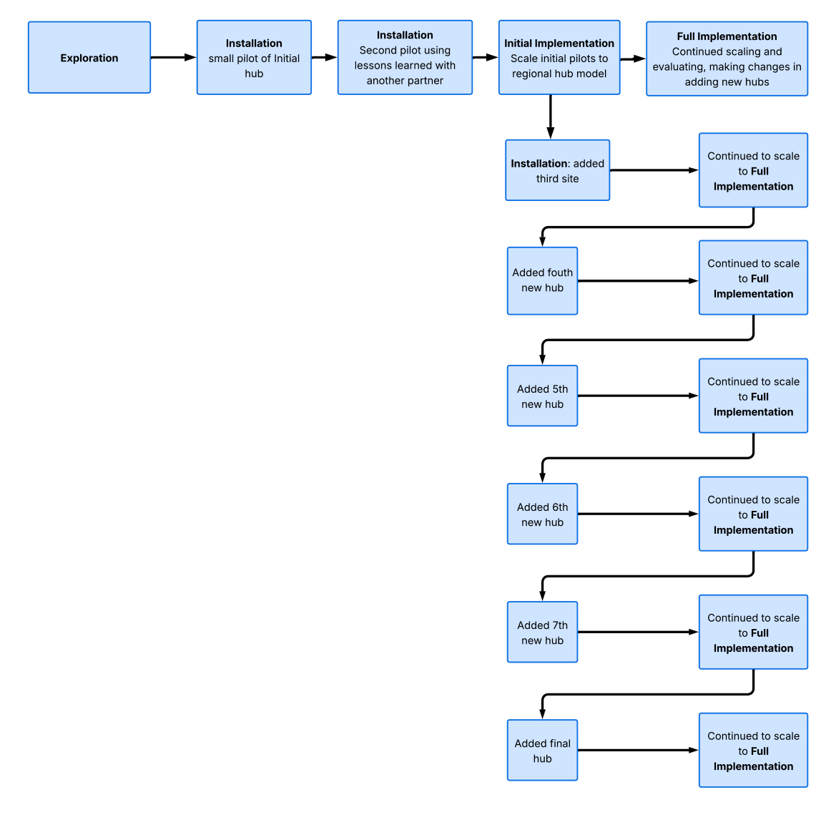
Implementation Framework is Not Linear
During scaling, individual sites operated in different phases simultaneously.
Impact
The Pediatric Behavioral Health Collaborative transformed care coordination by expanding small pilots into eight statewide hubs that integrated behavioral health into pediatric primary care. It improved provider capacity, with measurable gains in knowledge, skills, and confidence to manage children’s mental health needs, leading to better client outcomes. Continuous quality improvement cycles and intentional feedback loops created a culture of collaboration, trust, and adaptability across a range of stakeholders. Family leaders became equal partners, reshaping conversations and ensuring lived experience guided decisions. Sustained funding and alignment with Medicaid and the State Health Improvement Plan secured long-term scalability and fiscal sustainability.
Lessons Learned
- Start small with pilots, then scale gradually.
- Increase CYSHCN staff support and program awareness via branding and partnerships.
- Create standardization metrics earlier in the process.
- Consensus-building and definition alignment are critical for fidelity.
- Be willing to be adaptable and curious.
- Collaborate and build trust across stakeholders to drive long-term success.
- Use constructive conflict; have a space where people feel safe enough to give their opinions, and realize that we're going to come out with the best collective answer.
- Communicate continuously with families and create intentional feedback loops to support quality improvement.
- Use available tools, trainings, and resources.
- Prioritize the collective over individuals.
Quotes from Title V Leaders
Sustainability and Burnout:
We've had serious conversations with each other [in leadership] about [sustainability], and when things are going on in our life, because we feel like our work isn't done here, but [the innovation has] really tied us to this. I’m getting a little teary, but what keeps us here is the passion for it and fear that if we weren't here, would it just implode and then that would all be for naught. At the end of the day, I would love if it just said on my gravestone – ‘because she made a difference in one child's life.’ Like that's all we want to do. But we also recognize that we had to get other people on our team [involved] and build on that success, planning sustainability because we were burning out and could only do so much of the work. And so we've also had to say, ‘hey, we can only empower them the best that we can, but we can't be in every conversation, and they need to know to pull us in when they need to.’ But we also have other things that we've got to work on or they won't be sustainable as well. I have to trust that other people, they're going to do their best and that we give them what they need to do it. It wouldn't be exactly how I would do it, but they're going to go on to great things.
Best Practices When Working With Family Leaders:
With our QI work, we have a family partner who's a full team member at the table, and she asked the best questions, and then [the clinicians] learned to really trust her expertise. It’s been really amazing to see clinicians who have the best hearts and the best intentions, but then when you have that equal voice at the table with that family lens, it changes the conversation in a really great way- asking the curious questions. Did you hear about this? Have you ever heard of this? We do pay our family leaders, because in the field when we’re working with family partners, I would notice there would be like a lot of turnovers - because again they're in this role because of their lived experience, and then we're asking them to do more and at the end of the day we’re burning them out, or it’s compassion fatigue. And so we'd see like a lot of turnovers with that. So, I do think for teams that can, it's important to pay for that expertise and with that, then I think you get more consistent family stakeholders at the table, which then also helps, it helps with building trust.
Last Updated
02/27/2026
Source
American Academy of Pediatrics