The following are ideas for physical activity (PA) counseling & prescription for children at different levels of current PA and stages of readiness for change to improve PA levels. These examples can provide clinicians with language to use with patients and improve PA counseling and exercise prescription techniques.
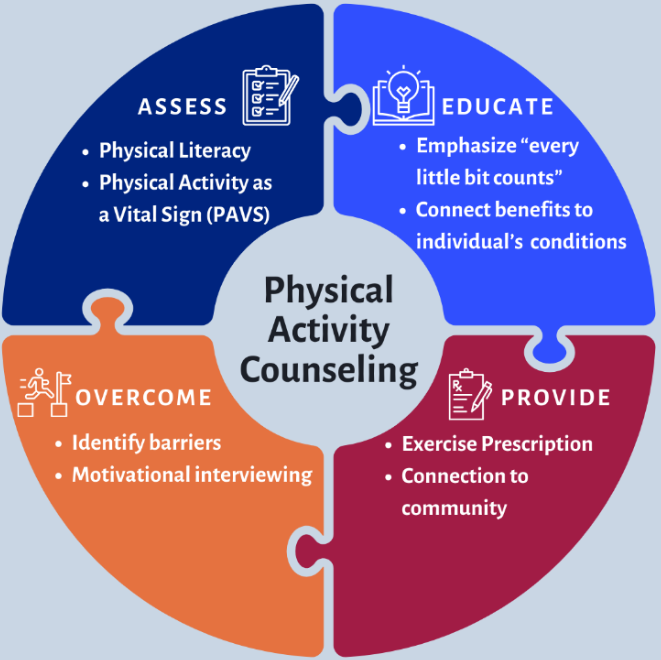
For the inactive and uninterested patient
Try THIS:
It can sometimes feel hard to find fun ways to be active. The good news is that being active doesn’t have to be a sport or anything that makes you sweat to still get good benefits! Going for a 5-minute walk after dinner a few days a week can help improve how you feel and how your body works and is a great way to catch up with your family if they walk with you!
NOT THAT:
At your age, you are supposed to be active for at least an hour every day. You need to be breathing hard for most of that time.
NOTES:
Readiness: When patients are not interested, giving them some simple ideas and keeping it positive may help them feel ready in the future to make changes. Using motivational interviewing techniques may help discover barriers and find solutions together. Tip: if the patient has any concerns (ie - depression), connecting physical activity to that health concern may help motivate someone who otherwise is not ready to become more active.
Intensity: Starting small with something achievable is more important than meeting moderate-to-vigorous intensity exercise.
Amount: A child who is not intentionally active nor excited about exercise is going to feel overwhelmed by 60 minutes per day. Small, achievable goals and regular follow up can be a great way to help patients make progress toward healthier lives!
For the currently inactive and interested patient
Try THIS:
Find a new way you like to move (like yoga, or a walk in the woods, or biking/riding a scooter) and try to do it once every day even if it is only a few minutes. Then come back in 2 months and share with me how it is going!
NOT THAT:
Go for a run every day and keep a log of how long you ran each day. Try to run for longer each week until you reach 60 minutes per day.
NOTES:
Simplicity: Keep the goal simple and try not to add too many steps that could feel like barriers. Keeping it small helps patients feel a sense of achievement if they can meet the goal.
Intensity/Time: Starting small with something achievable is more important than meeting moderate-to-vigorous intensity exercise. Meet the patient closer to where they are rather than jumping to the ideal time and intensity.
Type: Encouraging patients to find something they enjoy makes it more likely they will continue being active. Let the patient explore ways to move that are fun and find what works best as a starting point.
For the currently active patient who is NOT meeting recommended levels
Try THIS:
Exercise should be something you do every day. Try adding dancing for at least 20 minutes each day you are not already going to dance class to practice your routines. Adding some light weightlifting or planks or push-ups at least 3 days a week will help you in dance and help keep your bones healthy!
NOT THAT:
Exercising every day of the week is good for your mind and your body. On days you do not have dance class, try practicing portions of your dance routines on your own for at least 20 minutes. If you’re getting out of breath while dancing, you know your body is getting healthier! It is also good to do something to make your muscles stronger every day. Dance helps leg strength but may not always work on arm strength. If you have access to weights, you could try doing some lifting of weights that you can lift without too much effort at least 10 times. If you do not have access to weights, try doing some planks or push-ups focusing on keeping your shoulders in a good position on your back. This can help improve your posture during dance!
NOTES:
Simplicity: The first paragraph is simple and easier to remember. While the second example includes all good information, it is too lengthy.
For the currently active patient who IS meeting recommended levels
Try THIS:
Great job being active! We recommend getting exercise for at least 60 minutes every day and making sure you are doing activities that strengthen your muscles and bones at least 3 days per week. Being active keeps your mind and body healthy now and for the future. Doing activities that are fun makes it easy to be a lifelong active person!
NOT THAT:
Moderate-to-vigorous physical activity is recommended for at least 60 minutes every day. You are doing enough.
NOTES:
Reinforce: Emphasize the things that are going well with reminders of recommended types of activity.
Patients requiring additional support
Some patients who are struggling to achieve healthy levels of physical activity may benefit from additional support. The physical therapy or school-based options below may be particularly helpful for children who:
- Screened at “high risk for low levels of physical literacy, AND/OR
- Have difficulty participating in active play with peers or family
Physical therapy referral
For some patients, physical therapy may be the best option for performing the secondary screen and initiating additional intervention when appropriate.
Physical therapy should be considered for any patient with:
Current symptoms or discomfort during physical activity
AND/OR
Recent or ongoing injury or medical comorbidities
AND/OR
Insurance or other coverage with physical therapy benefits
Physical therapists are trained in the treatment of specific musculoskeletal diagnoses, and many are familiar with the concept of screening for fundamental movement skills. However, manymay not be familiar with physical literacy assessments per se, or the specific tools needed to perform the secondary screen and subsequent remediation. Rehabilitation specialists interested in further information on physical literacy and its assessment may benefit from reviewing Physical Literacy: A Manual For Community Partners And Rehabilitation Specialists
Referral for Physical Therapy Form
School-Based Programming and Adapting Physical Education
Some children may benefit from additional school-based support in physical education. Physical education is a critical component of a child’s overall educational experience, but children with low levels of physical literacy often struggle in standard physical education class settings and may benefit from a school-based assessment to determine the need for appropriate accommodations in physical education.
This may be a good fit for students with:
- An existing IEP or 504 plan
- Special health care needs or medical conditions that may benefit from an IEP or 504 plan
- Any condition or disability associated with deconditioning or that interferes with age-appropriate activity and/or participation in physical education.
- This includes a variety of medical conditions, such as autism spectrum disorder, ADHD, severe mood disorders, and obesity.
- A physical literacy/activity program developed by a rehabilitation professional that needs to be incorporated into school-based programming
Parents’ Role in Requesting Services:
Parents/caregivers are often not aware of their child’s rights to a school-based evaluation for the potential need for adapted physical education services and could be encouraged to request an “adapted physical education assessment” from the child’s school to determine eligibility for these services. This evaluation is often done through the school’s physical education teacher and is without charge. THESE REQUESTS NEED TO COME FROM THE PARENTS/CAREGIVER, AND NOT THE HEALTH CARE PROVIDER. Parents will then be asked to sign a consent for any assessment. It is important to note that the school may not agree that a child qualifies for an IEP or 504, and therefore, it will be necessary to ensure the family contacts the provider office if services with Adapted PE or School-Based PT were denied so that an alternative resource can be pursued.
Definitions:
- Individualized Education Program (IEP) for physical education: IEPs are most appropriate for children who meet disability criteria according to IDEA Sec 300.8 (see #3 below). Most common in this setting would include: autism, orthopedic disabilities, emotional impairments (such as significant anxiety or depression) and “other health impairments” that "impair strength, vitality, or alertness,” (such as ADHD, obesity, and asthma).
- 504 Plan: Adaptation of physical education class-based learning to accommodate the needs of the individual student (e.g. 504 plan) would be most appropriate for students who have unique needs for instruction in physical education, but do not meet disability criteria for an IEP.
- Definition of “child with a disability” according to the Individuals with Disability Education Act (IDEA): a child evaluated in accordance with §§300.304 through 300.311 as having an intellectual disability, a hearing impairment (including deafness), a speech or language impairment, a visual impairment (including blindness), a serious emotional disturbance (referred to in this part as “emotional disturbance”), an orthopedic impairment, autism, traumatic brain injury, other health impairment, specific learning disability, deaf-blindness, or multiple disabilities, and who, by reason thereof, needs special education and related services.
For ways to discuss physical activity, please visit our Physical Literacy page.
Last Updated
07/22/2026
Source
American Academy of Pediatrics