Internet Explorer Alert

It appears you are using Internet Explorer as your web browser. Please note, Internet Explorer is no longer up-to-date and can cause problems in how this website functions
This site functions best using the latest versions of any of the following browsers: Edge, Firefox, Chrome, Opera, or Safari.
You can find the latest versions of these browsers at https://browsehappy.com

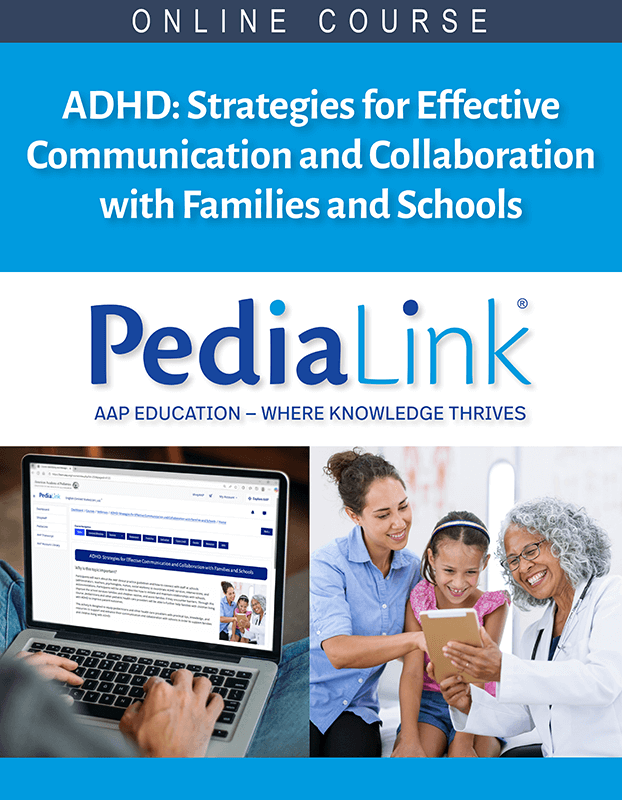
ADHD: Strategies for Effective Communication and Collaboration with Families and Schools

MOC

Available: 11/14/2025-11/13/2028

Format

Price: $0.00
Member Price: $0.00

Description

Participants will learn about the AAP clinical practice guidelines and how to connect with staff at schools (administrators, teachers, psychologists, nurses, social workers) to coordinate ADHD services, interventions, and accommodations. Participants will be able to describe how to initiate and maintain relationships with schools, improve the school services families and children receive, and assist families if they encounter barriers. Through this course, pediatricians and other pediatric health care providers will be able to further help families with children living with ADHD to improve patient outcomes.
This activity is designed to equip pediatricians and other health care providers with practical tips, knowledge, and resources to support and enhance their communication and collaboration with schools in order to support families and children living with ADHD.

Upon completion of this activity, learners will be able to

  • Understand the evidence base about school services and supports and be able to explain the AAP clinical guidelines to coordinate ADHD care with schools.

  • Understand the role and connection each person (ie, pediatrician, psychologist, school personnel, family, child) has related to diagnosis and treatment of ADHD.

  • Explain how to establish and maintain communication with schools, including support for school meetings.

  • Describe strategies to work with schools and families to coordinate ADHD services, interventions, and accommodations.

  • Explain barriers families may encounter when seeking school services and offer recommendations to families and the child (as appropriate) on how to advocate for services.

Course Details

  • Start Date: November 14, 2025
  • Online Access Expires: November 13, 2028
  • Credit Expires: November 13, 2028
  • Course ID: 62177

Acknowledgements

This project is supported by the Centers for Disease Control and Prevention (CDC) of the U.S. Department of Health and Human Services (HHS)  as part of a financial assistance award totaling $200,000 with 100 percent funded by CDC/HHS with an award number of 5NU01DD000032-02-00 The contents are those of the author(s) and do not necessarily represent the official views of, nor an endorsement, by the American Academy of Pediatrics (AAP), CDC/HHS, or the U.S. Government.

Faculty

George J DuPaul, PhD, MS, BA
Tanya Murphy, CBTAC, MBSRP
Toni M Whitaker, MD, FAAP
  • AMA PRA Category 1 Credit™

  • Enduring Materials

    1.00
  • AAP Credit Only

  • AAP Credit

    1.00
  • NAPNAP

  • NAPNAP Contact Hours

    1.00
  • MOC

  • MOC Part 2

    1.00
  • AAPA

  • AAPA Credit Hours

    1.00

Physician - ADHD: Strategies for Effective Communication and Collaboration with Families and Schools

The American Academy of Pediatrics (AAP) is accredited by the Accreditation Council for Continuing Medical Education (ACCME) to provide continuing medical education for physicians.

The AAP designates this enduring material for a maximum of 1.00 AMA PRA Category 1 Credit(s)™. Physicians should claim only the credit commensurate with the extent of their participation in the activity.

This activity is acceptable for a maximum of 1.00 AAP credits. These credits can be applied toward the AAP CME/CPD Award available to Fellows and Candidate Members of the AAP.

This activity is approved for 1.00 points of MOC Part 2 credit by the American Board of Pediatrics through the AAP MOC Portfolio Program.  All approved activities must be completed by the MOC Credit Approval End Date. All deadlines and MOC point values should be confirmed by checking the ABP Activity Catalog within each physician’s ABP Portfolio. Consult your ABP portfolio at www.abp.org for details about your specific certification requirements. For questions about how to access this activity, contact [email protected].


Allied Health Professional - ADHD: Strategies for Effective Communication and Collaboration with Families and Schools

The American Academy of Pediatrics (AAP) is accredited by the Accreditation Council for Continuing Medical Education (ACCME) to provide continuing medical education for physicians.

PAs may claim a maximum of 1.00 Category 1 credits for completing this activity. NCCPA accepts AMA PRA Category 1 Credit™ from organizations accredited by ACCME or a recognized state medical society.

This program is accredited for 1.00 NAPNAP CE contact hours of which 0.00 contain pharmacology (Rx) content, (0.00 related to psychopharmacology) (0.00 related to controlled substances), per the National Association of Pediatric Nurse Practitioners (NAPNAP) Continuing Education Guidelines. The AAP is designated as Agency #A17. Upon completion of the program, each participant desiring NAPNAP contact hours must send a completed certificate of attendance to [email protected]. Payment of $15 for NAPNAP members and nonmembers is required via credit card for all NAPNAP contact hour requests. Keep this certificate for your records for six (6) years. Requests for duplicate certificates should be made to the AAP.


Provider approved by the California Board of Registered Nursing, Provider Number 18014, for 1.00 contact hours

Recommended Browsers:

  • Microsoft Edge
  • Google Chrome
  • Firefox 2.0 and above
  • Opera 7.5 and above
  • Safari 1.3.2 and above

Recommended Browser Settings:

  • JavaScript enabled
  • Cookie enabled
  • SSL 2.0 & 3.0 enabled
  • Adobe Reader Plug-in (version 6.0+)

ADHD: Strategies for Effective Communication and Collaboration with Families and Schools

Price:: 0.00

Feedback Form