Pediatric guidelines part of global CPR guideline update
The American Academy of Pediatrics and the American Heart Association have published updated guidelines for cardiopulmonary resuscitation and emergency cardiovascular care for newborn and pediatric populations.
The “2025 American Heart Association and American Academy of Pediatrics Guidelines for Cardiopulmonary Resuscitation and Emergency Cardiovascular Care” mark a comprehensive update to the guidelines for pediatric basic and advanced life support and neonatal resuscitation since 2020. Experts from each organization co-led the three chapters — Pediatric Advanced Life Support, Pediatric Basic Life Support, and Neonatal Resuscitation, with writing groups evenly balanced between members of the American Heart Association and the American Academy of Pediatrics. The guidelines were jointly published online Oct. 22 in Circulation and Pediatrics as part of a comprehensive update of CPR and ECC recommendations for lifesaving resuscitation.
Every year, more than 7,000 out-of-hospital cardiac arrests and approximately 20,000 in-hospital cardiac arrests occur in infants and children in the United States. “Children are not little adults, and these guidelines offer specific recommendations that reflect the unique needs of children," said Javier Lasa, M.D., FAHA, FAAP, associate professor in critical care and cardiology at Children’s Health in Dallas and volunteer co-chair of the 2025 Pediatric Advanced Life Support Writing Group.
The Pediatric Basic and Advanced Life Support guidelines are intended to be a resource for lay responders and health care professionals who provide care for infants and children in multiple settings: the community, prehospital, and facility-based environment. Highlights from the new pediatric guidelines include:
- A single chain of survival is intended to apply to adult and pediatric in- and out-of-hospital cardiac arrest. In creating this singular chain, it is acknowledged that prior to cardiac arrest, prevention and preparedness can both avoid and optimize resuscitation.
- There is continued emphasis on early recognition of cardiac arrest in infants and children, and early activation of emergency medical services and the initiation of high-quality cardiopulmonary resuscitation beginning with chest compressions.
- For initial nonshockable rhythms, administering epinephrine as soon as possible is associated with favorable outcomes for infants and children in cardiac arrest.
- For infants with severe foreign body airway obstruction (FBAO), or choking, repeated cycles of 5 back blows alternating with 5 chest thrusts is recommended. Abdominal thrusts are not recommended in infants.
- In children with severe FBAO repeated cycles of 5 back blows alternating with 5 abdominal thrusts is recommended. Earlier guidance for children called for performing abdominal thrusts only. For infants, the recommended compression techniques include using either the 1-hand technique or the 2 thumbs–encircling hands technique. If the rescuer cannot physically encircle the chest, it is recommended to compress the chest with the heel of 1-hand . The use of 2 fingers along the sternum was eliminated due to ineffectiveness in achieving proper depth.
Henry Lee, M.D., FAAP, professor of pediatrics and neonatologist from the University of California San Diego and American Heart Association volunteer co-chair of the 2025 Neonatal Writing Group stressed the need for properly trained neonatal clinical care: "The guidelines also observe that one out of every 10-20 newborns each year needs help transitioning from the fluid-filled environment of the womb to the air-filled room. It is essential that every newborn infant has a health care professional dedicated to facilitating that transition who is trained and equipped for the role using these recommendations.”
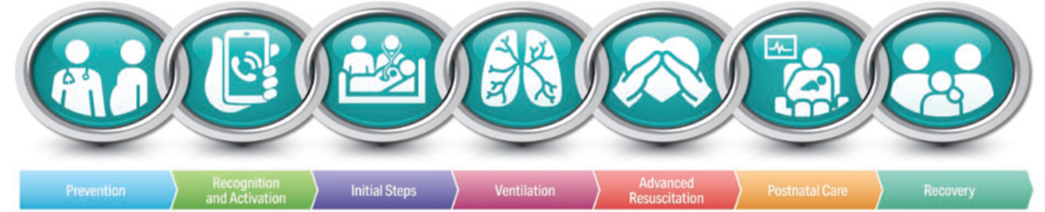
While an updated unified chain of survival has been developed for adults and children, a separate new newborn chain of care was created that provides a framework for considering essential elements of the health care system relating to neonatal health.
Highlights from the neonatal guidelines include:
- The newborn chain of care starts with prenatal care and extends to recovery and appropriate follow-up in the postnatal period to ensure optimal short- and long-term health for the infant and family.
- Newborn resuscitation requires anticipation and preparation by health care professionals who train individually and as a team.
- Most newborn infants can be evaluated and monitored during deferred cord clamping for 60 seconds or more and can maintain skin-to-skin contact with a parent after birth. Previously, the recommended duration was at least 30 seconds.
- Effective ventilation of the lungs remains the priority in newborn infants who need resuscitation.
- Some recommendations, such as chest compression positioning, timing of pulse oximeter placement, and ventilation corrective steps, are practices that may already be commonly performed but have been updated and strengthened with review of the latest evidence.
- It is reasonable to provide ventilation at a rate of 30–60 inflations per minute in newborn infants, which is expanded from the prior recommendation of 40-60 inflations per minute.
Volunteer writing group chairs representing both organizations participated in global launch events taking place simultaneously in Rotterdam, the Netherlands, the site of the 2025 International Liaison Committee on Resuscitation meeting. The updated guidelines and CPR training materials are available in U.S. and international English—with many additional translated languages planned—so first responders, clinicians, and other learners can begin using the most current, science-backed resources immediately. These educational materials can be accessed at the following links: Pediatric Advanced Life Support (https://heart.org/pals) and the Neonatal Resuscitation Program, 9th Edition (https://aap.org/nrp).
The American Academy of Pediatrics (AAP) and the American Heart Association (AHA) recognizes the work of the co-chairs of the groups:
Neonatal— Henry Lee, M.D., FAAP, FAHA and Edgardo Szyld, M.D., MS, FAAP; Pediatric Basic—Tia Raymond, M.D., MBA, FAAP, FAHA, FCCM and Benny Joyner, M.D., MPH, FAAP; Pediatric Advanced—Alexis Topjian, M.D., MSCE, FAHA and Javier Lasa, M.D., FAHA, FAAP.
Resources:
- Part 5: Neonatal Resuscitation: 2025 American Heart Association and American Academy of Pediatrics Guidelines for Cardiopulmonary Resuscitation and Emergency Cardiovascular Care
- Part 6: Pediatric Basic Life Support: 2025 American Heart Association and American Academy of Pediatrics Guidelines for Cardiopulmonary Resuscitation and Emergency Cardiovascular Care
- Part 8: Pediatric Advanced Life Support: 2025 American Heart Association and American Academy of Pediatrics Guidelines for Cardiopulmonary Resuscitation and Emergency Cardiovascular Care
###
About the American Academy of Pediatrics
The American Academy of Pediatrics is an organization of 67,000 primary care pediatricians, pediatric medical subspecialists and pediatric surgical specialists dedicated to the health, safety and well-being of infants, children, adolescents and young adults.
About the American Heart Association
The American Heart Association is a relentless force for a world of longer, healthier lives. Dedicated to ensuring equitable health in all communities, the organization has been a leading source of health information for more than one hundred years. Supported by more than 35 million volunteers globally, we fund groundbreaking research, advocate for the public’s health, and provide critical resources to save and improve lives affected by cardiovascular disease and stroke. By driving breakthroughs and implementing proven solutions in science, policy, and care, we work tirelessly to advance health and transform lives every day. Connect with us on heart.org, Facebook, X or by calling 1-800-AHA-USA1.