For asthma patients, no amount of e-cigarette exposure is no safer than tobacco smoke
SAN DIEGO —Household exposure to e-cigarettes increases the risk of asthma flare-ups in children, challenging the assumption that e-cigarettes are a “safer” source of secondhand smoke, according to research presented during the American Academy of Pediatrics 2026 National Conference & Exhibition in San Diego.
Authors of an abstract, “Parent-Reported Household Tobacco and E-cigarette Exposure and Asthma Control in Children: A Cross-Sectional Study,” used electronic health record data from a large, diverse pediatric primary care network to study more than 48,000 clinic visits over a 33-month period where parents of children age 1 or older with asthma reported on household tobacco and e-cigarette use. Household use of tobacco and e-cigarettes was reported in 5% of clinic visits, tobacco-only in 9%; and e-cigarette-only in 3% of the encounters.
“There is no safe level of tobacco or e-cigarette exposure when it comes to children. Parents and caregivers who use any tobacco or nicotine products should make every effort to quit, using evidence-based options like varenicline, nicotine replacement therapy, and counseling,” said Brian Jenssen, MD, MSHP, FAAP, associate professor of pediatrics, Children's Hospital of Philadelphia.
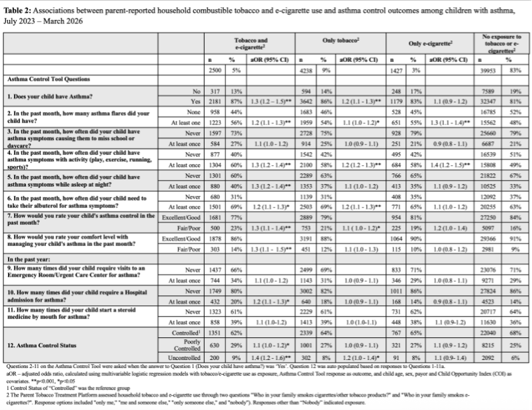
Researchers found that children exposed to both combustible tobacco and e-cigarettes in the home had the broadest and strongest links to poor asthma control: more flares, more night-time and activity-related symptoms, more rescue inhaler use, and more hospital admissions. Tobacco-only exposure showed more modest effects across fewer measures. But even e-cigarette-only exposure, on its own, was independently linked to more asthma flares and more activity-related symptoms.
“It reinforces the need for pediatric care teams to screen for all forms of household nicotine and tobacco use — not just cigarettes — and to offer cessation support for both, as part of routine asthma care,” he said.
“Many parents believe e-cigarettes are a safer alternative to cigarettes, both for themselves and for their children's health. Our findings suggest that assumption doesn't fully hold up for kids with asthma.”
The work was funded by the National Institutes of Health (grant R37-CA282153, PI: Brian Jenssen).
Media Relations Contact:
Natalie Solimeo at [email protected]
Dr. Jenssen is scheduled to present the research, which is below, at 3:40 p.m. PT, Saturday Oct. 3 at the Marriott Marquis, for the Section on Nicotine and Tobacco Prevention and Treatment, H2066.
In addition, Dr. Jenssen will be among highlighted abstract authors who will give brief presentations and be available for interviews during a “Soundbite Session” from noon- 1 pm PT Sunday, Oct. 4, in the conference center Press Office, 14A.
##
The American Academy of Pediatrics is an organization of 67,000 primary care pediatricians, pediatric medical subspecialists and pediatric surgical specialists dedicated to the health, safety and well-being of infants, children, adolescents and young adults. For more information, visit www.aap.org. Reporters can access the meeting program and other relevant meeting information through the AAP meeting website at http://www.aapexperience.org/
Abstract
Program Name: Call for Abstracts
Submission Type: Section on Nicotine and Tobacco Prevention and Treatment
Abstract Title: Parent-Reported Household Tobacco and E-cigarette Exposure and Asthma Control in Children: A Cross-Sectional Study
Brian Jenssen
[email protected]
Secondhand smoke worsens respiratory illnesses in children, particularly asthma. The impact of combined combustible tobacco and e-cigarette exposure on pediatric asthma control needs further investigation. Our objective was to examine associations between parent-reported household tobacco and e-cigarette use and parent-reported asthma control among children with asthma.
In this cross-sectional study, we used electronic health record data from an urban primary care network (July 2023 – March 2026). We included visits where parents of children aged ≥1 year with asthma diagnosis completed both a parent tobacco treatment platform (PTTP) and asthma control tool (ACT). The PTTP asked questions on who in the family smoked combustible tobacco and/or e-cigarettes. The ACT assessed asthma symptoms, control, medication use and healthcare utilization. Exposure was categorized as: both tobacco and e-cigarettes, tobacco only, e-cigarettes only, or none (reference). We used multivariable logistic regression to estimate adjusted odds ratios (aOR) and 95% confidence intervals (CI), adjusting for child age, sex, insurance and Child Opportunity Index (COI). The Children’s Hospital of Philadelphia IRB deemed this study exempt per the Common Rule.
Among 48,118 encounters (48% aged 6-12 years, 42% female, 34% Non-Hispanic Black, 43% Medicaid insured, 30% from very low COI neighborhoods; Table 1), household use of tobacco and e-cigarette was reported in 5% (n=2500), tobacco only in 9% (n=4238), and e-cigarette only in 3% (n=1427) of the encounters. After adjusting for covariates, combined tobacco and e-cigarette exposure was associated with activity-related symptoms (aOR 1.3, 1.2–1.4), nighttime symptoms (aOR 1.3, 1.2–1.4), albuterol use (aOR 1.2, 1.1–1.3), worse parent rating of asthma control (aOR 1.3, 1.1–1.4), lower parental comfort with asthma management (aOR 1.3, 1.1–1.5), hospital admissions in the past year (aOR 1.2, 95% CI 1.1–1.3), and both poorly controlled (aOR 1.1, 95% CI 1.0–1.2) and uncontrolled asthma status (aOR 1.4, 95% CI 1.2–1.6; Table 2). E-cigarette-only exposure was associated with more asthma flares (aOR 1.3, 95% CI 1.1–1.4) and activity-related symptoms (aOR 1.4, 95% CI 1.2–1.5), comparable to or exceeding combined exposure. Tobacco-only exposure showed more modest but significant associations across multiple domains. Parent-reported emergency department/urgent care utilization and oral steroid use were not significantly associated with any exposure type after adjustment.
Household tobacco and e-cigarette use, as reported by parents, are associated with worse parent-reported asthma control among children with asthma, even after adjusting for sociodemographic factors. E-cigarette-only exposure showed associations with asthma symptoms comparable to combined exposure, challenging assumptions that e-cigarettes pose low risk. Findings underscore the importance of comprehensive tobacco cessation counseling for families, including both combustible tobacco products and electronic products.
Table 1: Patient characteristics for visits where the Parent Tobacco Treatment Platform (PTTP) and the Asthma Control Tool (ACT) were completed for children with asthma, July 2023-March 2026
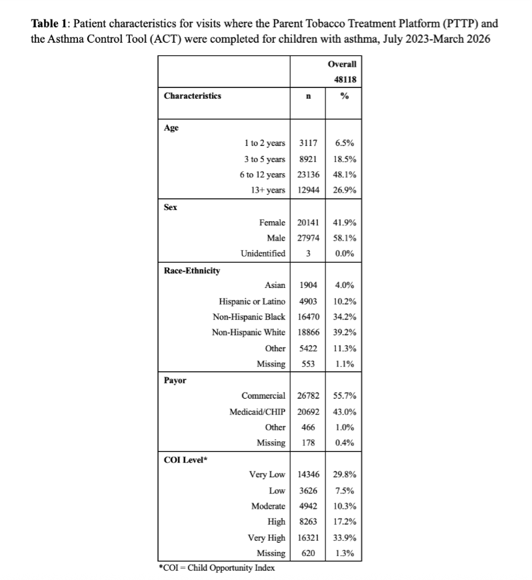
Table 2: Associations between parent-reported household combustible tobacco and e-cigarette use and asthma control outcomes among children with asthma, July 2023 – March 2026