Researchers describe positive results using Osteopathic Manipulative Treatment to treat Positional Plagiocephaly
SAN DIEGO —Physicians used osteopathic manipulative treatment to effectively improve the head shape of babies who developed a flattened spot on the back or side of their head, a condition called positional plagiocephaly (PP), according to research presented during the American Academy of Pediatrics 2026 National Conference & Exhibition in San Diego Oct. 2-6.
Authors of the abstract, “Safety and Feasibility of Osteopathic Manipulative Treatment (OMT) in Addressing Plagiocephaly,” studied 67 families whose infants underwent the treatment over ten visits. No serious adverse events occurred, showing OMT is safe and well-tolerated by infants, according to researchers.
"Families of infants with plagiocephaly often want treatment options that are gentle and non-invasive,” Kimberly Wolf, DO, FAAP, FACOP, FAAPO, NABBLM-C. “Our study demonstrates that osteopathic manipulative treatment is safe, well-accepted by families, and provides additional benefits for the baby’s health.”
Many babies develop a flattened spot on the back or side of their head in the first few months of life due to sustained pressure on one area, especially since pediatricians began recommending that babies sleep on their backs to reduce the risk of SIDS. The pressure on the baby's soft, still-forming skull causes it to flatten. Current management typically consists of repositioning strategies, such as encouraging more tummy time, physical therapy when appropriate, and helmet therapy for selected infants with persistent or more severe deformity.
“A flat head is a common reason parents bring their infants to the pediatrician in the first few months of life — yet until now, families have had strikingly few choices for treatment,” Dr. Wolf said. “Our research team wanted to know if there we could help close that gap — finding an option that works with the baby's own body to help improve the head’s shape and addresses the root causes behind the flat head.”
Parents whose infants completed the osteopathic manipulative treatment visits identified other secondary benefits, such as improved feeding, fussiness, reflux, and sleep, she said. Parents have highlighted how important the treatment has been as an alternative to helmets.
Media Relations Contact:
Kim J Wolf <[email protected]> [email protected]
Study author Kaur Sirjen, is scheduled to present their research, which is below, from 12 to 12:30 PM PDT on Sunday, Oct. 4 at the Marriott.
In addition, Dr. Wolf will be among highlighted abstract authors who will give a brief presentation and be available for interviews during a “Soundbite Session” from noon- 1 pm PDT Sunday, Oct. 4, in the conference center Press Office, 14A.
##
The American Academy of Pediatrics is an organization of 67,000 primary care pediatricians, pediatric medical subspecialists and pediatric surgical specialists dedicated to the health, safety and well-being of infants, children, adolescents and young adults. For more information, visit www.aap.org. Reporters can access the meeting program and other relevant meeting information through the AAP meeting website at http://www.aapexperience.org/
Abstract
Program Name: Call for Abstracts
Submission Type: Section on Osteopathic Pediatricians
Abstract Title: Safety and Feasibility of Osteopathic Manipulative Treatment (OMT) in Addressing Plagiocephaly
Sirjen Kaur
United States
[email protected]
10/03/2026 12:00 PM - 12:30 PM
Positional plagiocephaly (PP) is described as an asymmetrical flattening of the cranium due to sustained external pressure. PP creates asymmetric flattening usually of the occipital bone which leads to compensatory shifts of anterior structures, including orbits and middle ear. One clinical trial reported plagiocephaly in 205 out of 440 total infants between 7 to 12 weeks of age – totaling an incidence of ~46.6%. Also contributing to significantly increased numbers of referrals for evaluation and treatment of PP has been the “Back to Sleep” campaign which has led to a 600% increase in prevalence. We are conducting a two-arm, randomized cross-over clinical trial, the OPT-IN trial, looking at the benefit of osteopathic manipulative treatment (OMT) in the management of PP versus the standard of care of repositioning. This interim analysis examines the following question: “How safe and feasible is OMT for the treatment of PP in infants enrolled between 0-4 months of age?”
Key outcomes being examined for this poster are safety and feasibility. Safety is assessed by tabulating and describing adverse events as reported by families and the medical team. Feasibility outcomes, such as adherence to OMT are tabulated and family satisfaction summarized descriptively. Family satisfaction was examined through a feedback survey sent upon completion of the 8-week OMT intervention and focus groups which were conducted with the caregivers of participants also after completion of the OMT intervention. All family satisfaction data were collected and analyzed by consultants unknown to the families and who deidentified the data before sharing the results with the research team.
Preliminary results suggest that OMT has a favorable safety profile and is a feasible option for families in management of PP. Among the 67 families who completed the study, there is 100% compliance. This includes 10 visits total per participant: 8 OMT visits and 2 measurement visits. No serious adverse events have occurred, showing OMT is safe and well-tolerated by infants. Parents whose infants completed the OMT visits are satisfied with treatment and have identified multiple secondary benefits, such as improved feeding, fussiness, reflux, and sleep. Parents have highlighted how important OMT has been as an alternative to helmets, which were suggested as a treatment option to many families.
The results of our safety and feasibility analysis show OMT is a favorable treatment for infants with PP, and there were no significant adverse events. Concurrent symptoms (e.g. fussiness) reported were mild, not bothersome to the family, and resolved quickly. Parental feedback revealed that OMT yielded multiple secondary benefits and was “gentle, effective, and awesome.” OMT should be considered for families who are seeking a non-invasive treatment option for management of PP.
OPT-IN Roadmap
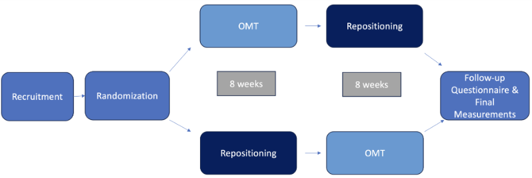
Randomized Crossover Design for the study
Parent Feedback on OPT-IN Benefits
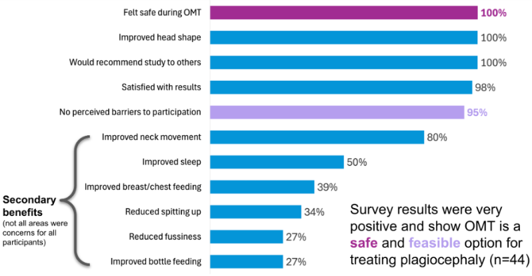
Survey results were very positive and show OMT is a safe and feasible option for treating plagiocephaly (n=44)