Audit of Instagram posts shows American Academy of Pediatrics was the exception in responding to misinformation
SAN DIEGO — Most public health institutions failed to respond in a timely way to misinformation on social media that falsely claimed that acetaminophen during pregnancy is linked to autism, according to research presented during the American Academy of Pediatrics 2026 National Conference & Exhibition.
Researchers reviewed public social media (Instagram) posts from 65 accounts including top children’s hospitals, medical societies, and state health departments, auditing accounts to assess their response to popular misinformation on this topic from September through November, 2025. They identified the American Academy of Pediatrics (AAP) as the fastest and most active account to respond during this time, according to authors.
“As social media grows in popularity as a source of medical information, it is imperative to understand the ways trusted sources communicate this information,” said author Jessica Visone, a medical student at Rutgers New Jersey Medical School. She will present the abstract, “Administrative Gaps in Digital Patient Engagement: An Audit of Institutional Responsiveness to the 2025 Acetaminophen-Autism Controversy,” during the Oct. 2-6 conference in San Diego.
“We need to ensure the right information is reaching the appropriate audiences to promote health and well-being for all. At a time of increased misinformation, there is nothing more powerful than the truth when it comes to population health.”
The research audits the timeliness and quality of digital communications from pediatric organizations following messaging from the White House on September 22, 2025, linking acetaminophen use to autism.
The analysis found only 14 of 65 institutions (21.5%) of the accounts posted anything relevant to correct false claims concerning the purported cause of autism. None of the state health departments addressed the topic and children’s hospitals took as long as 51 days to address the topic, according to research. The AAP responded on Day 1 and posted 10 relevant posts over the time period.
Of the 26 relevant posts analyzed, all used plain-language formatting and myth-busting framing, but the average reading level was well above the average 8th-grade reading level in the U.S., according to the research. No multilingual content was identified across any institution.
“Overall, through this audit of major pediatric health institutions, we found a limited and delayed response to an active health controversy,” Visone said. “Major health organizations have a responsibility to communicate with the populations they serve during times of increased health misinformation.”
The full team who contributed to this research included Kathryn Whitehill, MD, and medical students: Shivani Srivastava and Katherine Poole.
Media Relations Contact:
Lavene Gass, [email protected]
Contact: Jessica Visone
Email: [email protected]
Ms. Visone is scheduled to present a poster, described in the abstract below, between 11 am – 1 pm PT Saturday, Oct. 3 for the Section on Administration and Practice Management, H3062.
In addition, Ms. Visone, second-year medical student, will be among highlighted abstract authors who will give brief presentations and be available for interviews during a “Soundbite Session” from noon- 1 pm PT Sunday, Oct. 4, in the conference center Press Room, 14A.
##
The American Academy of Pediatrics is an organization of 67,000 primary care pediatricians, pediatric medical subspecialists and pediatric surgical specialists dedicated to the health, safety and well-being of infants, children, adolescents and young adults. For more information, visit www.aap.org. Reporters can access the meeting program and other relevant meeting information through the AAP meeting website at http://www.aapexperience.org/
Abstract
Submission Type: Section on Administration and Practice Management
Abstract Title: Administrative Gaps in Digital Patient Engagement: An Audit of Institutional Responsiveness to the 2025 Acetaminophen-Autism Controversy
Jessica Visone
[email protected]
In September 2025, claims linking prenatal acetaminophen use to autism spectrum disorder spread rapidly across social media, despite the lack of causal evidence. Pediatric families rely on trusted institutions, such as hospitals, state departments, and national organizations for accurate health information, yet little is known about how quickly and effectively these institutions respond during active health information controversies. This study audits the timeliness and quality of digital communications from pediatric organizations following messaging from the White House on September 22, 2025 linking acetaminophen use to autism, using guidance from the American Academy of Pediatrics (AAP) as a benchmark.
We conducted a cross-sectional audit of public Instagram accounts between September 22 and November 15, 2025, from 65 health organizations, including the top children's hospitals for pediatric and adolescent behavioral health, professional medical societies, and state health departments serving the largest pediatric populations. We measured time to first relevant post, proportion of controversy-related content, and communication quality. Quality was assessed using Flesch-Kincaid grade level, SMOG index, multilingual availability, and accessibility features. All analyses were conducted in R version 4.5.3.
Only 14 of 65 institutions (21.5%) posted content addressing the controversy. The AAP responded on Day 1 and published 10 relevant posts across the study period. No state health departments posted any relevant content. Among institutions that did post, hospital responses lagged up to 51 days behind the AAP. Non-responding institutions were not inactive: some published over 100 posts on unrelated topics during the same period, suggesting silence reflected administrative choice rather than limited capacity. Of the 26 relevant posts analyzed, 85% used plain-language formatting and myth-busting framing, but the average reading level was Flesch-Kincaid grade 11.4, well above the average 8th-grade reading level in the US. No multilingual content was identified across any institution.
The AAP demonstrated that rapid, high-quality digital communication is achievable during a fast-moving health controversy. Most pediatric hospitals and all state health departments in this sample failed to match that standard, leaving families without institutional guidance during an active misinformation event. These findings point to a gap in administrative infrastructure and policy, not just content. Pediatric health systems should develop standardized rapid-response protocols that include pre-approved messaging templates written at or below an 8th-grade reading level, multilingual content, and clear internal processes for activating effective and accessible communication during emerging controversies. This study offers a practical framework for evaluating and strengthening that capacity to improve accessibility of health information for pediatric families, especially during periods of widespread misinformation.
Figure 1. Timeline of Institutional Responses to the Acetaminophen–Autism Controversy.
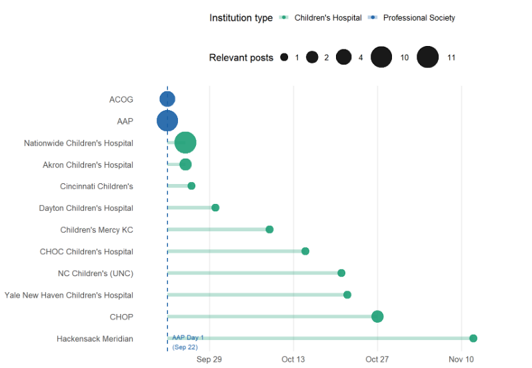
Horizontal bars represent the number of days from September 22, 2025, to each institution’s first relevant Instagram post, indicated by the point. Point size indicates the total number of relevant posts published by each institution during the study period. State health departments are not depicted due to lack of posts during study period.
Figure 2. Prevalence of Content Quality and Accessibility Features in Relevant Instagram Posts (n = 26).
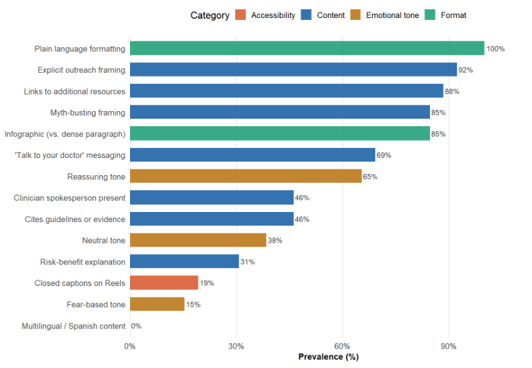
Percentages indicate the proportion of posts incorporating specific digital communication features, grouped by format, content framing, emotional tone, and accessibility.