Mary Pat Frintner, Elizabeth Gottschlich, Praveen Kumar, Ayesha Mirza, Prerna Sinha, Renuka Verma
Presented at the 2026 Pediatric Academic Societies Annual Meeting
Background: International medical school graduates (IMG) constitute almost 25% of the US physician workforce. In 2025, IMG made up over 25% of all pediatric matched applicants. Little research has focused on the characteristics, job search experiences and satisfaction of these residents.
Objective: Compare graduating pediatric residents’ characteristics, job search experiences and satisfaction by IMG and US medical school graduates (USMG).
Methods: National random samples of 1,000-1,200 graduating pediatric residents were surveyed between 2021-2025; 41% responded (analytic n=2274). Cross sectional responses were pooled. IMG was self-reported: graduated from a non-US medical school (residents have MD or equivalent degree). Residents were categorized: 1) non-US IMG: IMG who grew up outside US, 2) US-IMG: IMG who grew up in US, 3) USMG. Chi-square tests examined if differences existed between resident characteristics, job search experiences and residency satisfaction among the 3 groups. Multivariable logistic regression examined the independent effect of IMG on job search experiences and residency satisfaction adjusting for year and resident characteristics.
Results: Overall, 16% of graduating resident respondents were non-US IMG, 6% US-IMG and 79% USMG. Several resident characteristics and job search experiences varied by the 3 groups (Table 1). Non-US IMG were more likely than USMG to be 31 years or older (72% vs 48%, p<.001), race or ethnicity underrepresented in medicine (32% vs 13%, p<.001) and proficient in languages other than English (86% vs 27%, p<.001). They were less likely than USMG and US-IMG to report educational debt of >$200,000 (6% vs 53% and 71%, p<.001) and more likely than USMG to have a fellowship position (50% vs 37%, p<.001). Nine in 10 reported they would choose pediatrics again with no significant differences across the 3 groups.
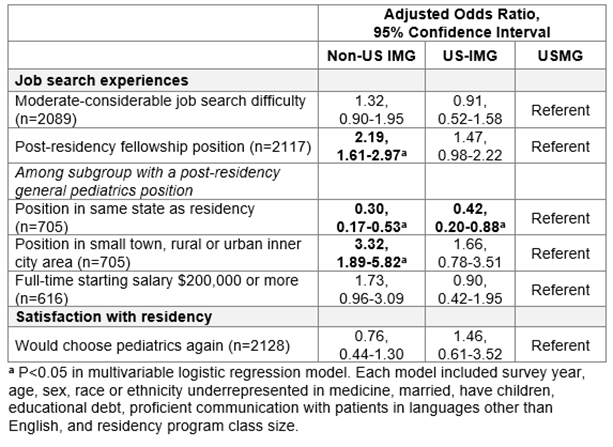
In multivariable analysis (Table 2), compared to USMG, non-US IMG had higher odds of having a post-residency fellowship position (aor 2.19, 95% CI 1.61-2.97) and a general pediatrics position in a small town, rural or urban inner-city area (aor 3.32, 95% CI 1.89-5.82). Both non-US IMG and US-IMG had lower odds of starting a general pediatrics position in the same state as residency.
Conclusion: Overall, one in 5 graduating residents is an IMG. Their backgrounds and career paths differ from US graduates, bringing diversity in race, ethnicity and languages to the workforce. More non-US IMG provide care in small town, rural, and/or urban inner-city areas and choose subspecialty pathways, helping with the gap both in rural areas and subspecialty workforce.
Table 1. Graduating Pediatric Residents’ Characteristics, Job Search Experiences, and Satisfaction with Residency (2021-2025): Non-US IMG, US-IMG, and USMG
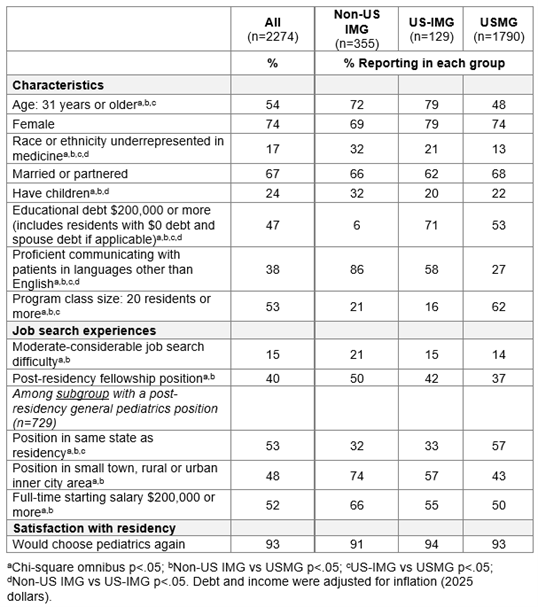
Table 2. Multivariable Results: Association of IMG Group with Job Search Experiences and Satisfaction with Residency (2021-2025)
Last Updated
05/05/2026
Source
American Academy of Pediatrics