Tylar Kist, Elizabeth Gottschlich, Faith Crittenden, Kerri Machut
Presented at the 2026 Pediatric Academic Societies Annual Meeting
Background: Career decisions are complex and multifaceted. Data on the timing of and factors important in the decision to pursue pediatrics can help facilitate discussion around the recruitment of future pediatricians.
Objective: Describe graduating residents’ a) timing of their decision to pursue a career in pediatrics, b) factors of importance in their career decision and c) satisfaction with this decision. Examine factors of importance in career decision by resident characteristics.
Methods: We utilized data from a national random sample of 1200 US pediatric residents from the 2025 American Academy of Pediatrics Annual Survey of Graduating Residents. Residents reported when they made the decision to pursue a career in pediatrics (before medical school, during the preclinical phase of medical school, or during the clinical phase of medical school), how important 8 factors were in helping them choose the specialty of pediatrics, and whether they would choose to do a pediatrics residency again (yes, no). Chi-square tests compared reported importance (essential or very important vs somewhat important or unimportant) of the 8 factors in choosing pediatrics by resident characteristics: medical school location, degree, sex, and planned to practice primary care when entered residency.
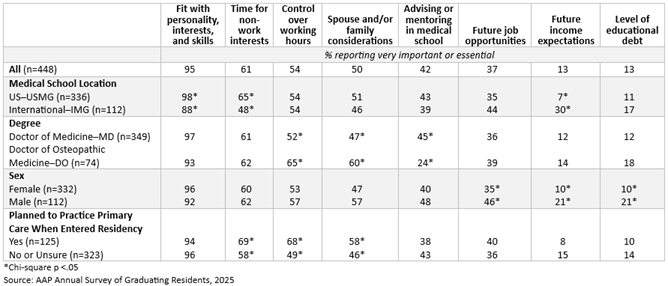
Results: Survey response rate was 38% (analytic n=448). 37% of graduating residents reported they made the decision to pursue pediatrics before medical school, 7% during the preclinical phase of medical school, and 56% during the clinical phase of medical school. Nearly all reported fit with personality, interests and skills as essential (71%) or very important (25%) in choosing pediatrics (Figure). Few (13%) reported future income expectations or educational debt as essential or very important. All 8 factors examined varied by at least 1 resident characteristic (Table). For example, graduating residents with MD degrees were more likely to report advising or mentoring during medical school as essential or very important compared to their DO counterparts (45% vs 24%, p<.01). International medical school graduates were more likely than US graduates to report future income expectations as essential or very important (30% vs 7%, p<.001). Overall, 94% of residents would choose a pediatrics residency again.
Conclusion: Nearly two-thirds of graduating residents decided to pursue a career in pediatrics during medical school, and almost all residents would choose pediatrics again. Our findings indicate there may be opportunities for advising and mentoring in osteopathic medical school training to help recruit future pediatricians.
Figure 1. Importance of Factors in Decision to Pursue a Career in Pediatrics
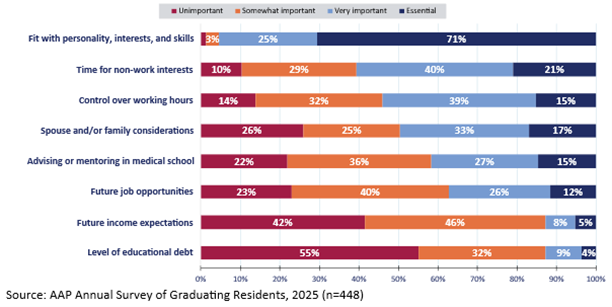
Table 1. Importance of Factors in Decision to Pursue a Career in Pediatrics by Resident Characteristics
Last Updated
05/05/2026
Source
American Academy of Pediatrics