Mary Pat Frintner, Gary Freed, Bobbi Byrne, Elizabeth Gottschlich, William Cull
Presented at the 2026 Pediatric Academic Societies Annual Meeting
Background: There is considerable range in reported physician burnout depending on the measure used, but a general increase was reported during the COVID-19 pandemic. It is unknown whether indicators of burnout among pediatricians remained at high levels in post-pandemic years.
Objective: Utilize the uniqueness of a longitudinal design to examine over time if 1) indicators of burnout reported by the same pediatricians have changed 2021-2024 and 2) patterns of burnout are similar across key pediatrician characteristics.
Methods: Data from the AAP Pediatrician Life and Career Experience Study (PLACES), a national longitudinal cohort study, were used to examine changes in 4 indicators of burnout over a 4-year period, 2021 to 2024. Among 3 age cohorts (N=8107 responses from 2316 participants; mean age in 2024=45 yrs), participation rates ranged 76%-79%. We examined annual responses to 4 indicators of burnout: 1) current burnout in work, 2) emotionally exhausted and distressed to degree of having nothing else to give, 3) disconnected or cynical towards patients or families, 4) not accomplishing anything worthwhile at work. Mixed-effects logistic regression for longitudinal analysis examined trends in the 4 burnout indicators over time for: 1) all participants and 2) pediatrician subgroups (sex, age cohort, medical school location, received subspecialty fellowship training) using separate models for each subgroup.
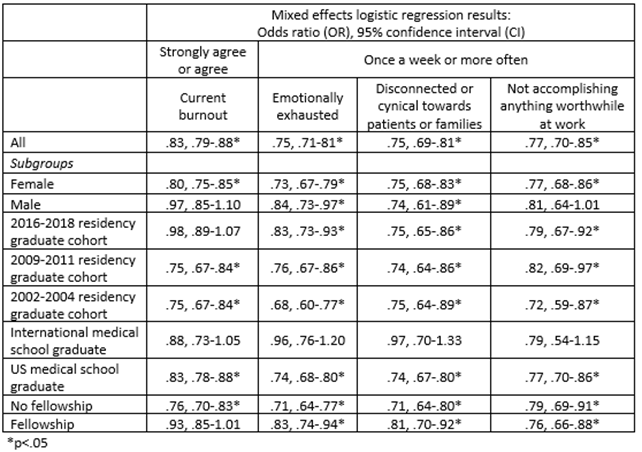
Results: All 4 burnout indicators significantly decreased over time (figure). Nearly half (46%) of pediatricians in 2021 and 39% in 2024 reported they were experiencing burnout, p<.001. Fewer pediatricians reported experiencing the other 3 indicators of burnout. Mixed effects models also showed significant decreases in these indicators over time for all pediatricians and for most pediatrician subgroups examined (Table). For example, among female pediatricians, current burnout (OR .80, 95% CI .75-.85), emotionally exhausted (OR .73, 95% CI .67-.79), disconnected or cynical (OR .75, 95% CI .68-.83), and not accomplishing anything worthwhile (OR .77, .95% CI .68-.86) all decreased over time. Only among international medical school graduates was no significant decrease over time found for all 4 indicators.
Conclusion: Despite oft expressed concerns, across 2021-2024, fewer pediatricians reported experiencing burnout, emotional exhaustion, depersonalization, and no worthwhile accomplishments at work. This was consistent across most pediatrician subgroups. It will be important to continue monitoring this trend as challenges in medicine continue to increase.
Figure 1. Pediatrician Reports of Burnout Indicators Over Time, 2021-2024
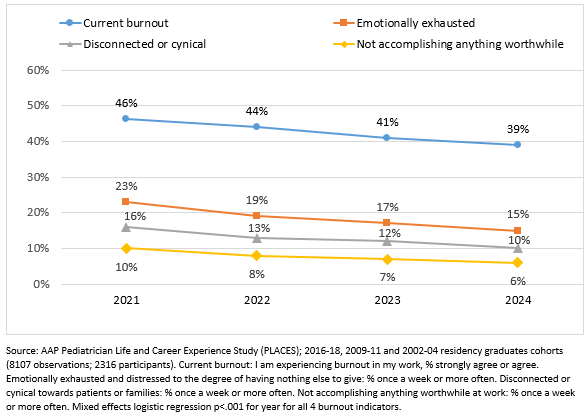
Table 1. Longitudinal Analysis: Trends in Pediatrician Reports of Burnout Indicators by Subgroup Over Time, 2021-2024
Last Updated
05/05/2026
Source
American Academy of Pediatrics