Kuo D, Foster CC, Burr WH, Kirby CA
Presented at the 2025 Pediatric Academic Societies Annual Meeting
Background: About 1 in 6 US children have a disability. Pediatricians have raised concern about the time and resources needed to support children with disabilities (CWD).
Objective: To describe experiences of pediatricians who provide services for CWD, including relationships between pediatricians’ characteristics, practice type, and barriers to services for CWD.
Methods: The 2023 AAP Periodic Survey, a nationally representative survey of non-retired US AAP members (primary care and subspecialists), included questions on caring for CWD (response rate=33%, N=658). Data weighted by age and gender for nonresponse bias. Respondents who care for children >1 year were asked about the frequency with which they cared for children with different kinds of disability and barriers to care. Chi-square tests examined associations between barriers to caring for CWD and pediatrician and practice characteristics. Multivariable logistic regression examined the independent effects of pediatrician and practice characteristics on the top three reported barriers to caring for CWD (large or moderate barrier vs small or not a barrier).
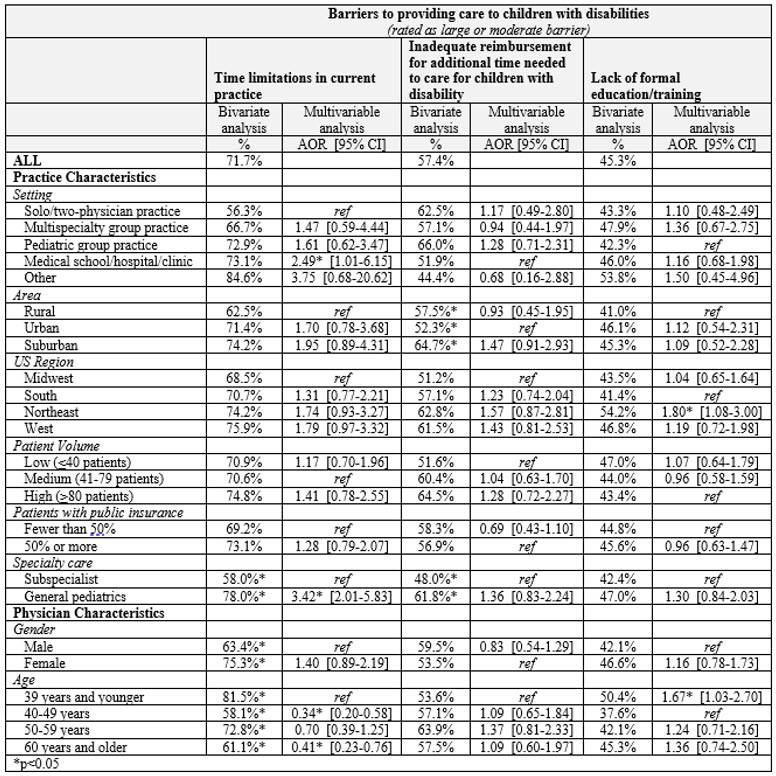
Results: Nearly all respondents strongly agreed (87%) or agreed (11%) that understanding the needs of patients with disability is valuable to them as a physician. More than 9 in 10 (92%) reported providing care to CWD, with most providing care for a range of disabilities – 84% gross motor disability, 77% fine motor disability, 91% communication disability. Most typically cared for only a few CWD per week (mean weekly CWD patient volume=3.8). The top three reported barriers to caring for CWD were time limitations (72%), inadequate reimbursement (57%), and lack of formal education/training (45%). Other barriers included lack of experience treating CWD (29%) and lack of interest in making caring for CWD a larger part of my practice (19%). Younger pediatricians and those practicing general pediatrics were more likely to report time limitations as a barrier to caring for CWD, and these associations remained significant when adjusting for the other pediatrician and practice characteristics [Table].
Conclusion: Pediatricians reported time, payment, and training as barriers to caring for CWD, and two of the top three reported barriers (time and payment) were more pronounced for general pediatricians.
Table 1. Association between Reported Large or Moderate Barriers to Caring for CWD and Practice and Pediatrician Characteristics
Last Updated
05/15/2025
Source
American Academy of Pediatrics