Burr WH, Somberg CM, Olson LM
Presented at the 2025 Pediatric Academic Societies Annual Meeting
Background: In 2016, the American Academy of Pediatrics (AAP) recommended screening for social determinants of health at routine visits. Research is lacking on how pediatricians’ attitudes and practices have changed since the recommendation.
Objective: Compare US primary care pediatricians’ reported attitudes and practices in supporting patients in families with financial hardship in 2014 and 2023.
Methods: We examined primary care pediatricians’ attitudes and practices using AAP Periodic Surveys conducted in 2014 and 2023. Each survey was a nationally representative sample of non-retired US AAP members (residents excluded). Response rates were 47% in 2014 and 41% in 2023. Data were collected on: a) attitudes toward the role of pediatricians to address financial hardship; b) rate which they routinely screen families with financial hardship for 5 specific needs; c) referrals in the past 12 months for 6 different resources. Chi-square tests compared pediatrician responses in 2014 and 2023 for attitudes (yes vs no), screening practices (almost always, usually vs sometimes, almost never) and referrals (yes vs no). Multivariable logistic regression examined the independent effect of year adjusted for core practice characteristics (practice area, setting, region, % patients in families with financial hardship, % patients covered by public insurance).
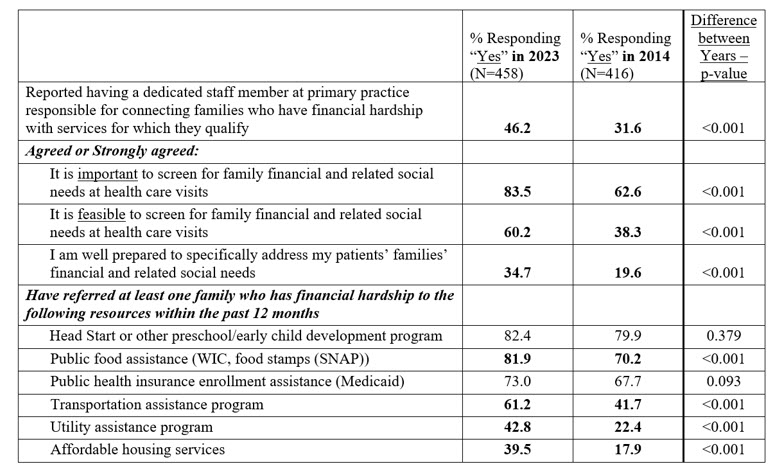
Results: In 2023, 83.5% of primary care pediatricians agreed it is important to screen for family financial and related social needs, compared to 62.6% in 2014 [Table]. More pediatricians in 2023 reported feeling well prepared to address their patients’ financial and social needs (34.7% vs 19.6% p<.001). Pediatricians in 2023 were also more likely to report they almost always or usually ask families who have financial hardship on 4 out of the 5 financial and related social needs queried [Figure]. The largest increases were found for food insecurity (52.7% vs 18.5% p<.001) and housing insecurity (44.1% vs 16.8% p<.001), respectively. Pediatricians in 2023 were more likely to have referred families on 4 out of the 6 financial and related social need resources (transportation assistance, food assistance, housing services, utility assistance) [Table]. All the significant bivariate relationships remained significant in the multivariable models, except for referring to public food assistance.
Conclusion: From 2014 to 2023 there was a significant increase in the number of pediatricians reporting they screen and refer families for financial and related social needs. They were also more likely to endorse screening for families’ needs and feel well prepared to address them.
Figure 1. Primary Care Pediatricians’ reported Practices Inquiring About Financial and Other Related Social Needs in 2014 & 2023
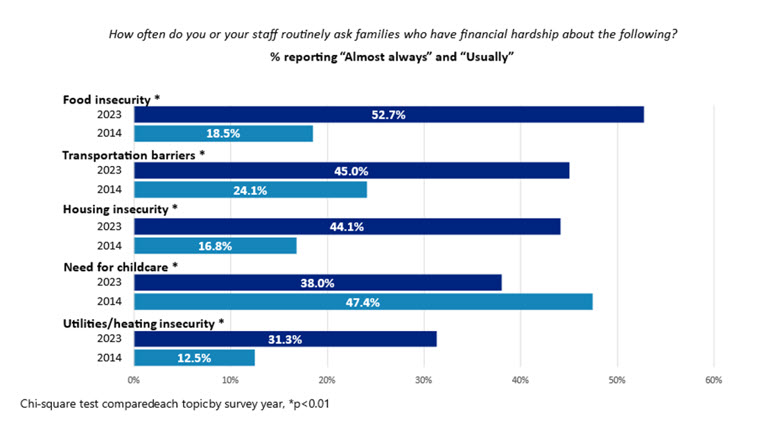
Table 1. Primary Care Pediatrician Attitudes and Reported Practices Providing Referrals for Families Who Have Financial Hardship in 2014 and 2023
Last Updated
05/15/2025
Source
American Academy of Pediatrics