James Perrin, Eliana Perrin, Suk-fong Tang
Presented at the 2026 Pediatric Academic Societies Annual Meeting
Background: The growing crisis in primary care across the age span has drawn attention to the low financing and payment for primary care. Several states have worked to increase the percent of total health care spending on primary care to 12-15%. Yet a “one size” fits all approach may not actually benefit children, in part because children have much lower total expenditures, with fewer hospitalizations and surgical procedures. Children insured by Medicaid have higher rates of chronic health conditions and thus might have lower percent spend in primary care than children in general. Knowing pediatric health expenditures for primary care clarifies change needed to benefit children and meet pediatric work force needs.
Objective: To determine percent of total spending devoted to primary care and trends over time, by payer type (commercial vs. Medicaid) and age group.
Methods: Retrospective analysis of person- and event-level data from 2002-2022 Medical Expenditure Panel Survey. We identified office-based and outpatient department primary care visits and associated payments and calculated total per-capita annual medical expenditures. We then estimated share of total medical spending attributable to primary care, stratified by age group (0-18, 19-45, 45-64, and >65 years), insurance type, and time period (2002-08, 2009-15, 2016-2022).
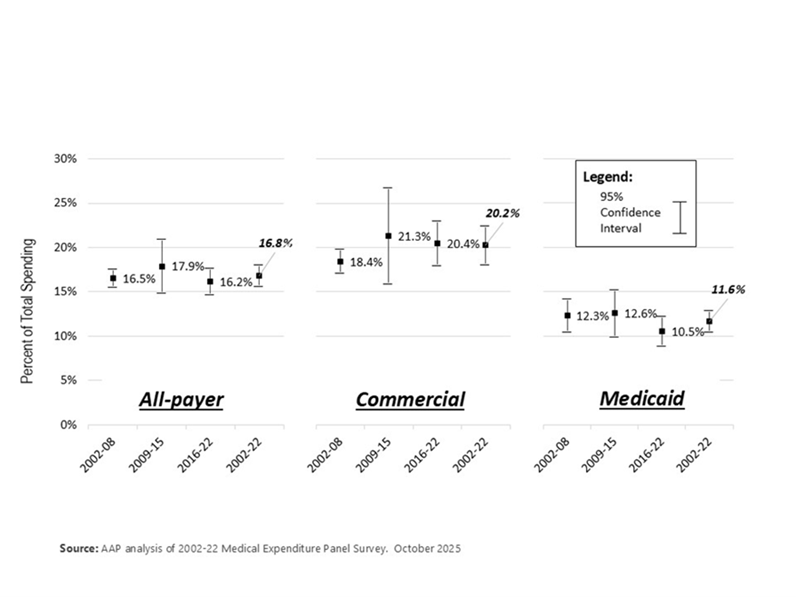
Results: Primary care accounted for 7.0% of total US health expenditures across all age groups. Children 0-18 years had the highest proportion of spending on primary care (16.8%), compared to 6.5% among non-elderly adults (19-64 years) and 5.6% for > 65 years (Figure 1). Primary care comprised 20.2% of expenditures for children with commercial insurance and 11.6% for Medicaid-insured children. We found no significant trends over time (Figure 2).
Conclusion: Percent expenditure on primary care for children is substantially higher than for older populations and higher for commercial than Medicaid insurance. Higher percents arise from both lower spending on high-cost healthcare for children and lower payments to pediatric subspecialists and hospitals. Efforts to improve financing of primary care should address these differences in pediatric and adult care by calling for proportional increases for all age groups rather than targeting a uniform percentage that pediatrics may already surpass.
Figure 1. Primary Care Expenditure as Share of Total Medical Spending by Payment Source by Patient Age Group, 2002-22
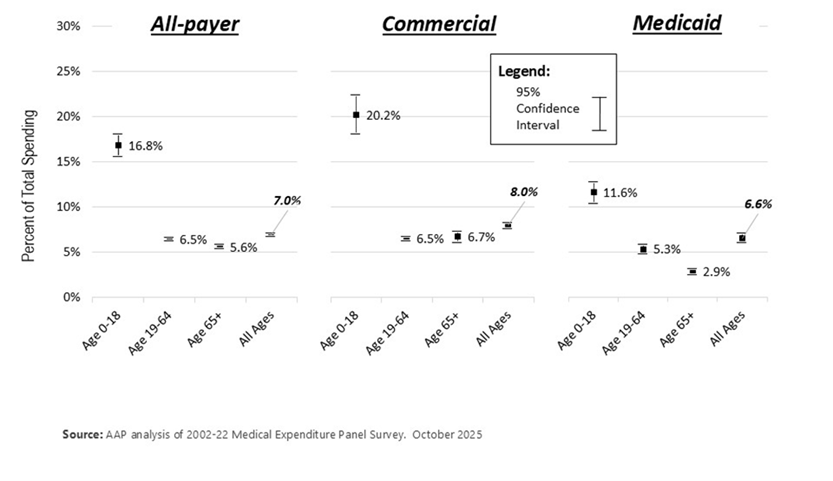
Figure 2. Primary Care Expenditure as Share of Total Medical Spending, by Payment Source by Time of Period, Patient Aged 0-18 Years, 2002-22
Last Updated
05/05/2026
Source
American Academy of Pediatrics