Macario E, Davis K, Steffes J, Humiston S, Szilagyi P, Kelly MK, Albertin C, Rand C, Fiks AG
Presented at the 2025 Pediatric Academic Societies Annual Meeting
Background: HPV vaccination coverage remains lower than US goals. The NIH-funded STOP-HPV trial developed 3 sequential online modules to help clinicians communicate with parents about HPV vaccination. The modules raised coverage in participating AAP Pediatric Research in Office Settings (PROS) practices. However, the modules have not been offered to a broader population.
Objective: To pilot-test the feasibility of an AAP PROS-State Title V partnership and of disseminating STOP-HPV modules to health professionals via a Title V program and assess a) participant experiences with the modules and b) Title V staff’s thoughts on dissemination success.
Methods: AAP PROS worked with HRSA to disseminate the STOP-HPV modules via the Michigan Title V program and its partners (Figure 1). In May-July 2024, these partners emailed URLs for each module to about 9,000 health professionals with up to 4 reminder emails. Continuing medical education credit was offered to participants completing the modules. Participants completed a 10-item survey on reasons for participating, training satisfaction, and plans for changing practice strategies. Title V staff were interviewed about facilitators to scaling the project.
Results: Over 3 months, 390, 365, and 290 professionals completed Modules 1, 2, and 3, respectively.
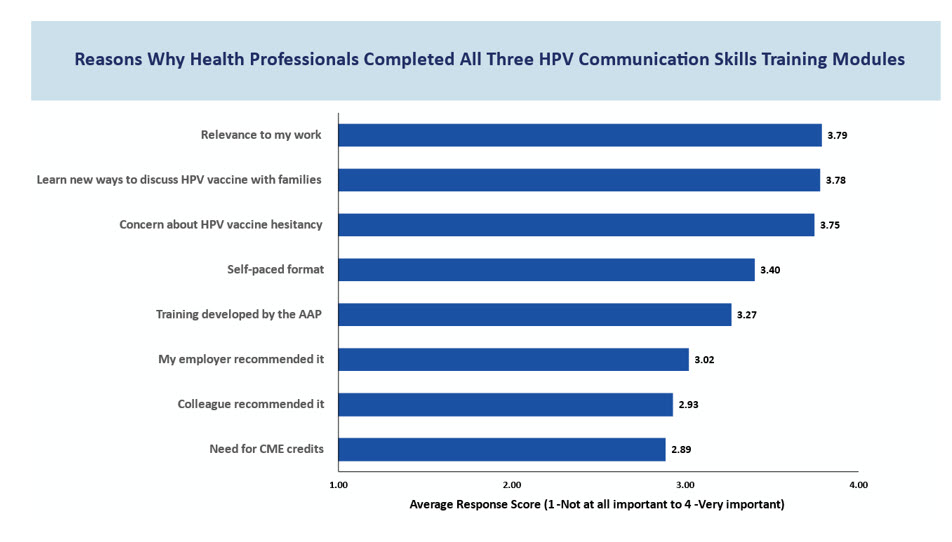
SURVEY: Among those who completed all 3 modules (n=290), 76% were nurses, 50% worked in Vaccines for Children provider sites, and 79% were based in local health departments. Top reasons for taking the training included relevance to work, to learn new ways to discuss the HPV vaccine, and addressing HPV vaccine hesitancy (Figure 2). Participants said they learned new information (e.g. oropharyngeal cancer is now more common than cervical cancer) in an interactive manner. About 80% said they planned to change practice strategies based on the training: they will present HPV, Tdap, and meningococcal vaccines together in the same way, focus on cancer prevention and engage all office staff in promoting HPV vaccination. Almost 70% claimed CME credit. INTERVIEW: All Title V staff (n=5) said key factors for partnership success were having a centralized Title V liaison, ready-to-use materials, trusted partner intermediaries, and buy-in from Michigan Department of Health and Human Services leadership.
Conclusion: Results demonstrate the feasibility and completion of an evidence-based intervention disseminated widely via a state Title V program. Title V served as a vehicle for bringing HPV vaccination communication training, developed for research, to a broader audience with a minimal 5-email effort.
Figure 1. Michigan Title V Program Partner Intermediaries that Promoted the 3-Educational Module HPV Communication Skills Training
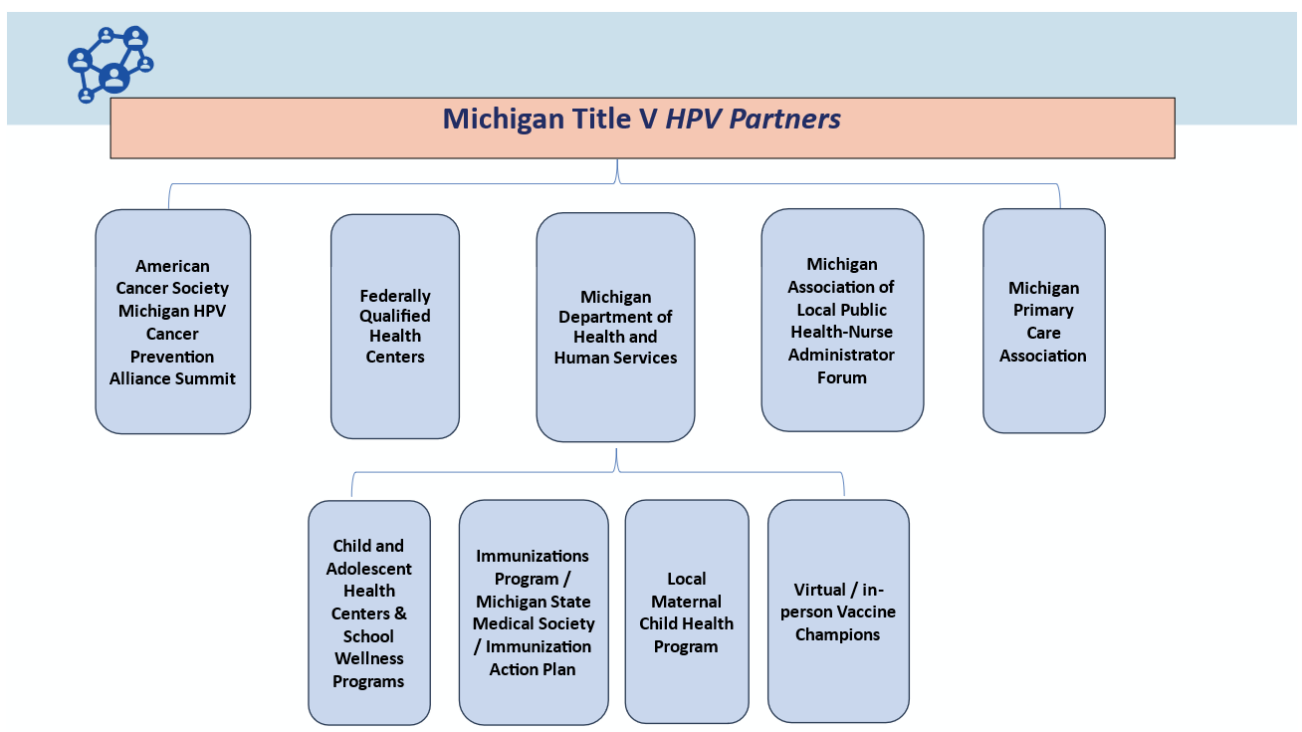
Figure 2. Reasons Why Health Professionals Completed All Three HPV Communication Skills Training Modules
Last Updated
05/15/2025
Source
American Academy of Pediatrics