Elizabeth Gottschlich, Tylar Kist, Faith Crittenden, Kerri Machut
Presented at the 2026 Pediatric Academic Societies Annual Meeting
Background: Graduating pediatric residents face both opportunities and challenges as they transition from residency and embark on their career in pediatrics. Little is known about their concerns during this transition period and how these might have changed over time.
Objective: Describe residents’ concerns as they transition from residency to their next position and compare topics of concern among graduates in 2018 and 2025.
Methods: We utilized data from national random samples of US graduating pediatric residents in 2018 (n=1,000) and 2025 (n=1,200) from the American Academy of Pediatrics Annual Survey of Graduating Residents. Each year, residents were asked about their level of concern (not concerned, somewhat concerned, concerned, very concerned) around 8 topics as they transitioned to their next position. Survey responses were pooled and chi-square tests compared residents’ reported concern (% concerned or very concerned) about each topic in 2018 and 2025. Multivariable logistic regression examined the independent effect of survey year on reported concern for each topic, adjusting for core resident characteristics (age, sex, medical school location, and post-residency position).
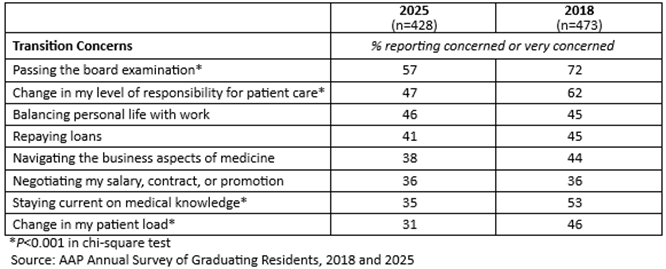
Results: Response rates were 49% in 2018 and 38% in 2025 (analytic n=901). Graduates in 2025 reported they were least concerned about the change in their patient load (31%) and most concerned about passing the board exam (57%); Figure. Compared to 2018 graduates, residents graduating in 2025 were less likely to report concern about 4 of the topics assessed and equally likely to report concern about the remaining 4 topics (Table). For example, fewer residents in 2025 than in 2018 reported concern about passing the board exam (57% vs 72%, p<.001), and almost half of residents in 2025 (46%) and 2018 (45%) were concerned about balancing their personal life with work (p=0.61). All significant bivariate relationships were significant in the multivariable models; compared to 2018 graduates, residents graduating in 2025 had lower odds of reporting concern about passing the board exam (aOR=0.54, 95% CI=0.40-0.72), change in level of responsibility for patient care (0.53, 0.40-0.70), staying current on medical knowledge (0.49, 0.37-0.64), and change in patient load (0.52, 0.39-0.69).
Conclusion: The biggest transition concern for both 2018 and 2025 pediatric graduates was passing the board exam, highlighting a potential need for strategies to support test preparation. However, residents graduating in 2025 were equally or less concerned about all topics assessed compared to 2018 graduates.
Figure 1. US Graduating Pediatric Residents’ Self-Reported Concerns as They Transition to Their Next Position, 2025
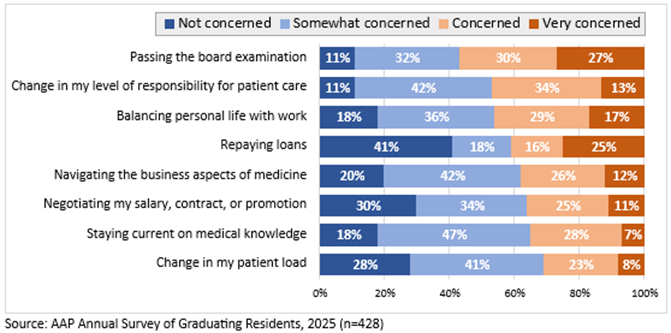
Table 1. US Graduating Pediatric Residents’ Self-Reported Transition Concerns by Survey Year
Last Updated
05/05/2026
Source
American Academy of Pediatrics