William Cull, Dave Prentice, Suk-fong Tang
Presented at the 2026 Pediatric Academic Societies Annual Meeting
Background: Following the COVID-19 pandemic, child vaccination has received increased scrutiny and completion rates have likely fallen. Certain patient subgroups may be disproportionately impacted.
Objective: Measure trends in flu vaccination among US children from 2023 to 2025 and examine differences by demographic subgroups.
Methods: Data were obtained from the National Immunization Survey-Flu (NIS-Flu), a nationally representative telephone survey of households with children aged 6 months to 17 years. Parental reports of vaccination status were collected annually through April for the 2023, 2024, and 2025 flu seasons. Each year, over 130,000 interviews were completed, and responses were not verified by medical records. Survey weights accounted for complex sampling design. Coverage was analyzed overall and by subgroups defined by child age, maternal education, household income, race/ethnicity, and urbanicity. Differences from 2023 to 2025 and between subgroups were assessed using 95% confidence intervals.
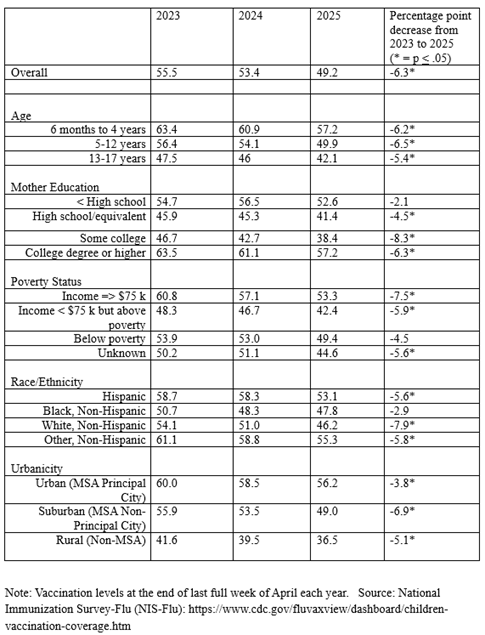
Results: Between 2023 and 2025, the percentage of US children receiving a flu vaccination was reduced from 55.5% to 49.2%. The overall decrease of 6.3 percentage points was statistically significant, and further statistically significant decreases were found for 15 out of 18 subgroups examined. The largest declines occurred for children with mothers who had some college education but no college degree (decrease of 8.3 percentage points), white, non-Hispanic children (decrease of 7.9 percentage points), and children from families making 75 thousand dollars per year or more (decrease of 7.5 percentage points).
In 2025, the subgroups with the highest percentages of immunization were children aged 6 months to 4 years (57.2%) and children with mothers with a college degree (57.2%). The difference in immunization was especially large between children in urban areas (56.2%) and children in rural areas (36.5%).
Conclusion: By 2025, fewer than half of children in the US received a flu immunization. Declines across most demographic groups highlight growing child vulnerability.
Table 1. Trends in Percentage of US Children (Ages 6 Months to 17 Years) Receiving Flu Immunization by Family Characteristics, 2023-2025
Last Updated
05/08/2026
Source
American Academy of Pediatrics