Blake Sisk1, Susan J. Kressly2, Julia Richerson3.
1American Academy of Pediatrics, Elk Grove Village, IL; 2Kressly Pediatrics, PC, Warrington, PA; 3Family Health Centers of Louisville, Louisville, KY.
Presented at the 2017 Pediatric Academic Societies Annual Meeting.
Background: The role of retail-based clinics (RBCs) in U.S. healthcare delivery has expanded in recent years, but questions remain about the consequences of this development for pediatrics. In particular, there has been little examination of pediatricians' experiences with and attitudes toward RBCs.
Objective: Examine trends from 2008-2016 in pediatricians' unfavorable experiences with and attitudes toward RBCs and assess predictors of those experiences and attitudes.
Methods: Data from nationally representative Periodic Surveys of American Academy of Pediatrics members in 2008 (n=176; response rate=58%) and 2016 (n=242; 50%). Sample restricted to general practitioners who provide direct patient care and have an RBC in their practice area. Three dependent variables were analyzed: 1) Negative experiences with RBCs; 2) Decline in office visits due to RBCs; 3) Concern about competition from RBCs (positive experiences/attitudes were not available in the survey). T-tests were used to assess differences across surveys, and logistic regression models were estimated separately for each dependent variable (predictors: survey year, gender, age, hours worked per week, practice area, region, and setting).
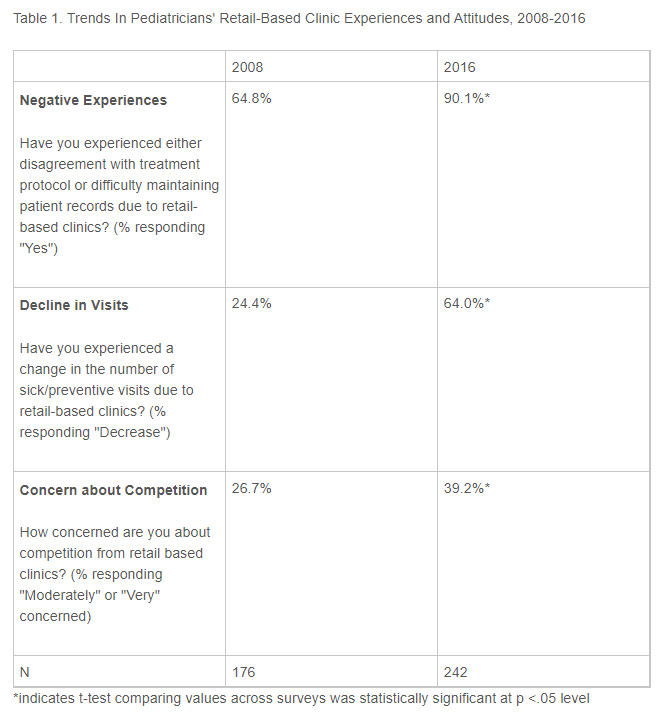
Results: 70% of pediatricians in 2016 reported having an RBC nearby, up from 44% in 2008 (p<.05). In 2016, 85% stated that the availability of RBCs negatively impacts pediatricians' ability to provide care (2008 not available). Compared to 2008, more pediatricians in 2016 (p<.05) reported negative experiences (65% in 2008 to 90% in 2016), a decline in visits (24% to 64%) and concern about competition (27% to 39%). Logit models indicate that, all else equal, pediatricians in 2016 (vs. 2008) were significantly more likely to report negative experiences (AOR 4.77, 95% CI 2.73-8.34) and a decline in visits (AOR 5.38, 95% CI 3.34-8.65). Suburban pediatricians (vs. urban) were more likely to report negative experiences, group practice/HMO pediatricians (vs. small practice) were more likely to report a decline in visits, and older pediatricians were more likely to report concern about competition.
Discussion: As the number of RBCs has grown, pediatricians in 2016 reported more unfavorable experiences with and attitudes toward RBCs relative to 2008. The findings indicate efforts are needed to improve continuity of care, as well as to examine the effect of RBCs on pediatric practice and the medical home.
Last Updated
10/18/2021
Source
American Academy of Pediatrics