Elizabeth Gottschlich, Tylar Kist, Juan Chaparro, Lauren Hess, Mary Pat Frintner
Presented at the 2026 Pediatric Academic Societies Annual Meeting
Background: Artificial intelligence (AI) in healthcare is growing rapidly. Limited data exist on AI use and perceptions among pediatricians and by age.
Objective: Examine pediatricians’ use of and concerns about AI in healthcare and variation by age cohort.
Methods: We used national weighted survey data from the AAP Pediatrician Life and Career Experience Study (PLACES), a longitudinal cohort study (2016-18, 2009-11 and 2002-04 residency graduates; mean ages: 39, 46 and 53 years, respectively), collected April-July 2025. PLACES participants reported if they used AI-enabled tools at work in the past 12 months. Those who had were asked about a) frequency of 8 possible uses and b) use of AI scribes to generate patient visit notes in the past 12 months. Those who used AI scribes were asked about impacts on their work (2 items). Participants also reported concerns about AI (6 items) and effects of AI on pediatrics (2 items). Chi-square assessed variation in AI use and concerns by age cohort.
Results: Survey participation was 63% (n=1609). Overall, 48% reported they used AI at work in the past 12 months. Among this subgroup, the most common uses (reported as often or very often) were clinical notes and documentation (28%), staying current on new medical information (15%), and academic work (14%); Fig 1. 39% had used AI scribes; among these respondents, most agreed or strongly agreed this reduced time spent on clinical documentation (77%) and enabled them to focus more on patients (86%).
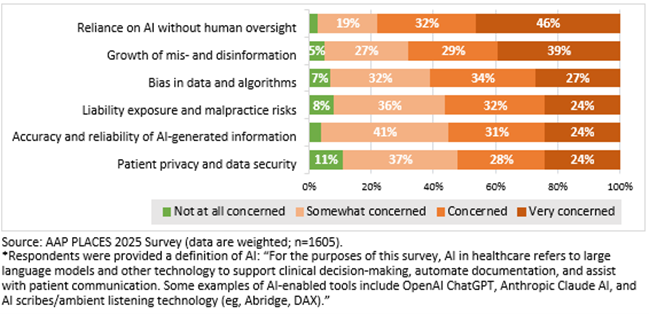
Among all participants, 27% were more excited than concerned about the potential increased use of AI in their work, 52% equally concerned and excited and 21% more concerned than excited. Reliance on AI without human oversight was the top concern reported (78% concerned or very concerned); Fig 2. Regarding the effects of AI on pediatrics, 68% were concerned or very concerned about the overall impact on children and adolescents; only 6% were confident or very confident that AI tools are being developed with adequate consideration of the pediatric patient population.
Participants’ reported uses of AI and concerns did not vary by age cohort except for AI use in the past 12 months, with 2002-04 residency graduates less likely than 2009-11 and 2016-2018 graduates to use AI (43% vs 50% vs 51%; p<.01).
Conclusion: Nearly half of PLACES pediatricians were using AI with little variation by age. Four in 10 of these pediatricians used AI scribes with most reporting benefits of increased efficiency and more time with patients. Pediatricians were both excited and concerned about AI, with the top concern being reliance on AI without human oversight.
Figure 1. PLACES Pediatricians’ Reported Frequency of Using AI* in Their Work (Among Those Who Used AI in the Past 12 Months)
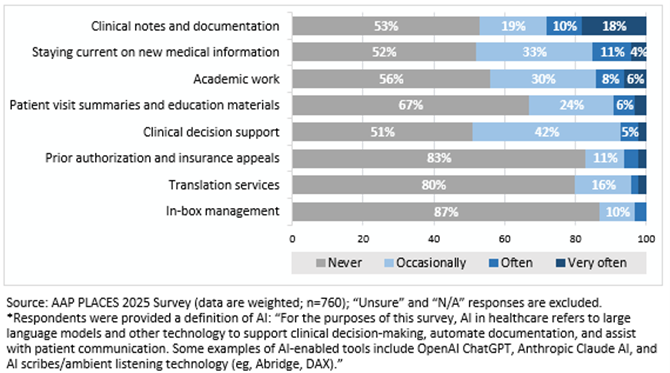
Figure 2. PLACES Pediatricians’ Reported Concerns About AI* in Healthcare
Last Updated
05/05/2026
Source
American Academy of Pediatrics