Internet Explorer Alert

It appears you are using Internet Explorer as your web browser. Please note, Internet Explorer is no longer up-to-date and can cause problems in how this website functions
This site functions best using the latest versions of any of the following browsers: Edge, Firefox, Chrome, Opera, or Safari.
You can find the latest versions of these browsers at https://browsehappy.com

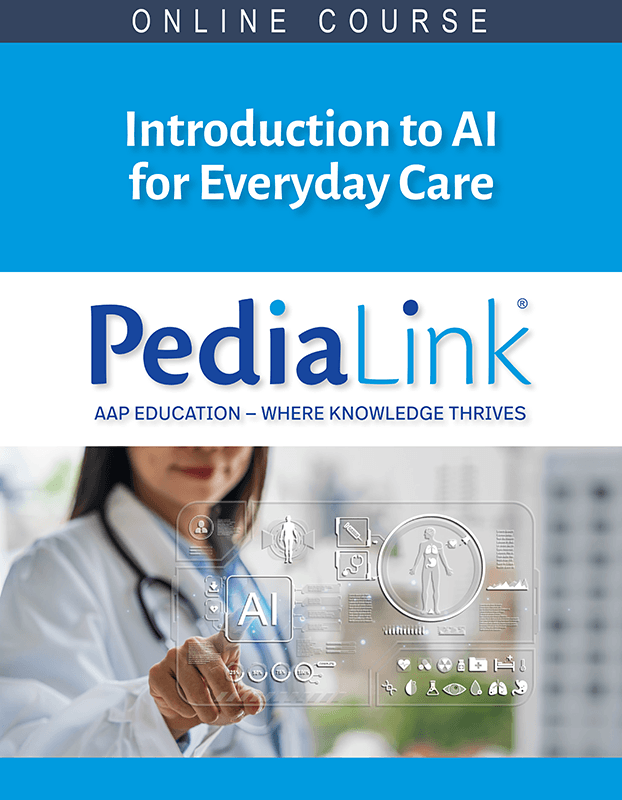
Introduction to AI for Everyday Care

MOC

Available: 06/05/2026-06/04/2029

Format

Price: $90.00
Member Price: $60.00

Description

Pediatric practice is increasingly shaped by new digital tools, yet most clinicians are being asked to use artificial intelligence (AI) without clear guidance on what it actually is, when it helps, or when it creates risk.

This introductory, asynchronous course is designed to help pediatricians clinicians make sense of AI in practical and, clinical context. Participants will learn how AI can support clinical judgment and patient care by helping with common workflow challenges such as documentation, patient education, communication tasks, and clinical decision-making. Along the way, the course clarifies the difference between traditional AI and generative AI (GenAI), introduces simple strategies for interacting effectively with AI tools, and builds confidence in evaluating when AI use is appropriate.

Grounded in real pediatric scenarios, the course emphasizes thoughtful adoption. Learners will explore where AI performs well, where it struggles, and why pediatric care requires particular attention to safety, bias, developmental nuance, and attributes of entrustment trust. Practical examples, including emerging tools such as ambient documentation systems, while illustrating meaningful successes and failures, considering its limitations, safety, ethical aspects.

By the end of the course, clinicians will leave with a clear mental framework and concrete, low-risk ways to begin incorporating AI responsibly to reduce administrative burden, strengthen communication with families, and protect time for what matters most: caring for children.

By the end of this activity, learners will be able to:

  1. Distinguish between artificial intelligence (AI) and generative AI (GenAI) using examples relevant to pediatric clinical practice.
  2. Recognize appropriate, low-risk ways AI can support workflows pertaining to pediatrics, including documentation, communication, and patient education tasks.
  3. Use simple prompting strategies to guide AI tools toward clinically useful outputs while maintaining appropriate clinician oversight.
  4. Identify situations in which AI use may introduce risk by considering safety, ethics, bias, trust, and pediatric-specific factors.
  5. Critically evaluate AI-generated tools and its content for accuracy, appropriateness, and safe use with children and families.
  6. Develop a personal approach for responsibly integrating AI into daily clinical practice and advocating for pediatric-specific product design and implementation.


Course Details

  • Start Date: June 5, 2026
  • Online Access Expires: June 4, 2029
  • Credit Expires: June 4, 2029
  • Course ID: 62537

Faculty

Subject Matter Experts

  • Jennifer Benjamin, MD, MS
  • Amy Molten, MD
  • Srinivasan Suresh MD, MBA, FAAP

Course Reviewer

  • James Barry, MD, MBA

Pediatrician Member Fee: $60

Medical Student Member Fee: $10

Resident Member Fee: $10

Post Residency Training Member: $10

Non-Member: $90


  • AMA PRA Category 1 Credit™

  • Enduring Materials

    1.50
  • NAPNAP

  • NAPNAP Contact Hours

    1.50
  • MOC

  • MOC Part 2

    1.50
  • AAPA

  • AAPA Credit Hours

    1.50

Physician - Introduction to AI for Everyday Care

The American Academy of Pediatrics (AAP) is accredited by the Accreditation Council for Continuing Medical Education (ACCME) to provide continuing medical education for physicians.

The AAP designates this enduring material for a maximum of 1.50 AMA PRA Category 1 Credit(s)™. Physicians should claim only the credit commensurate with the extent of their participation in the activity.

This activity is approved for 1.50 points of MOC Part 2 credit by the American Board of Pediatrics through the AAP MOC Portfolio Program.  All approved activities must be completed by the MOC Credit Approval End Date. All deadlines and MOC point values should be confirmed by checking the ABP Activity Catalog within each physician’s ABP Portfolio. Consult your ABP portfolio at www.abp.org for details about your specific certification requirements. For questions about how to access this activity, contact [email protected].


Allied Health Professional - Introduction to AI for Everyday Care

The American Academy of Pediatrics (AAP) is accredited by the Accreditation Council for Continuing Medical Education (ACCME) to provide continuing medical education for physicians.

PAs may claim a maximum of 1.50 Category 1 credits for completing this activity. NCCPA accepts AMA PRA Category 1 Credit™ from organizations accredited by ACCME or a recognized state medical society.

This program is accredited for 1.50 NAPNAP CE contact hours of which 0.00 contain pharmacology (Rx) content, (0.00 related to psychopharmacology) (0.00 related to controlled substances), per the National Association of Pediatric Nurse Practitioners (NAPNAP) Continuing Education Guidelines. The AAP is designated as Agency #A17. Upon completion of the program, each participant desiring NAPNAP contact hours must send a completed certificate of attendance to [email protected]. Payment of $15 for NAPNAP members and nonmembers is required via credit card for all NAPNAP contact hour requests. Keep this certificate for your records for six (6) years. Requests for duplicate certificates should be made to the AAP.


Recommended Browsers:

  • Microsoft Edge
  • Google Chrome
  • Firefox 2.0 and above
  • Opera 7.5 and above
  • Safari 1.3.2 and above

Recommended Browser Settings:

  • JavaScript enabled
  • Cookie enabled
  • SSL 2.0 & 3.0 enabled
  • Adobe Reader Plug-in (version 6.0+)

Introduction to AI for Everyday Care

Price:: 90.00

Feedback Form