Kristin Davis, Mary Kate Kelly, Donna Harris, Jennifer Steffes, Everly Macario, Samuel Wittman, Janani Ramachandran, Matthew Jones, Brigit Hatch, Julia Szymczak, Jonathan Yabes, Robert Grundmeier, Kristin Ray, Alexander Fiks
Presented at the 2026 Pediatric Academic Societies Annual Meeting
Background: Glucagon-Like Peptide-1 Receptor Agonists (GLP-1s) are recommended as an adjunctive treatment to lifestyle interventions for weight loss in children 12 years and older. Little data, however, exist on the evolving use of GLP-1s in primary care populations.
Objective: To describe the use of GLP-1 medications in a sample of primary care patients of national scope from 2020-2024.
Methods: Our retrospective cohort study used electronic health record data from 1127 community health centers, 76 health system-affiliated pediatric practices, and 45 independent pediatric practices in the American Academy of Pediatrics (AAP) Pediatric Research in Office Settings (PROS) network. We formed our analytic cohort from patients 12 to <18 years with a primary care visit between 2020-2024. We describe changes in use over time and frequency of diabetes and obesity diagnoses in the population of patients receiving GLP-1 medications across all five years.
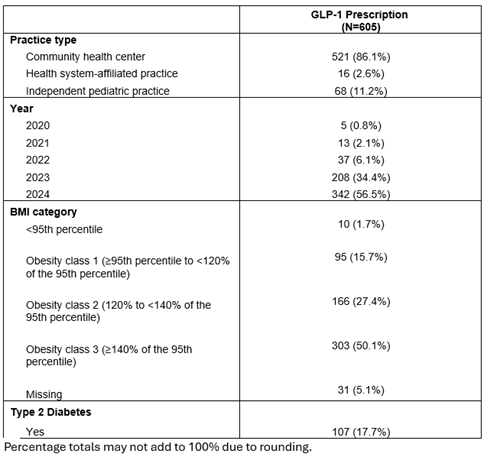
Results: Our cohort included 1,011,183 youth 12 to <18 years. Overall, 57% of youth were seen in a community health center, 28% in a health system-affiliated practice, and 15% in independent pediatric practices. Among this cohort, 5, 13, 37, 208, and 342 youth received a GLP-1 in 2020, 2021, 2022, 2023, and 2024, respectively. Over the five years, a total of 605 youth (<0.1% of the overall population) were prescribed a GLP-1. Of those youth, nearly all (564, 93.3%) were at or above the 95th percentile (obesity classes 1-3). Specifically, 95 (15.7%) met criteria for class 1, 166 (27.4%) for class 2, and 303 (50.1%) for class 3 obesity. Nearly 1 in 5 (107, 17.7%) had a Type II diabetes diagnosis.
Conclusion: Despite substantial growth in the use of GLP-1s, GLP-1 use is exceedingly rare in this primary care population of national scope.
Table 1. GLP-1 Prescriptions and Associated Clinical Conditions, 2020-2024
Last Updated
05/05/2026
Source
American Academy of Pediatrics