Melissa Stockwell, Alisa Stephens Shields, Mary Kate Kelly, Alessandra Torres, Janani Ramachandran, Everly Macario, Celibell Vargas, Donna Harris, Miranda Griffith, Denise Smith Rodd, Timothy Proctor, Fabiana Izquierdo, David Norton, Alexander Fiks
Presented at the 2026 Pediatric Academic Societies Annual Meeting
Background: COVID-19 and influenza are leading causes of child death. Vaccination is effective against severe disease, but rates are low. Behaviorally-informed pediatric COVID vaccine text messages have not been tested. It is also unknown how COVID and influenza vaccine reminders may interact.
Objective: To compare the effectiveness of behaviorally-informed text message reminders vs usual care on timely COVID-19 or influenza vaccination in an RCT with national scope.
Methods: Messages in English and Spanish were created using behavioral science principles informed by the Increasing Vaccination Model, previous studies and FrameWorks Institute’s Immunization Toolkit, and then pretested with parents. The AAP PROS network recruited 9 practices, across 7 states. Randomization occurred at the family level, stratified by site, age, and prior year’s COVID/influenza vaccination rates using randomly permutated blocks into 4 arms: combined COVID and influenza vaccine messages, COVID vaccine reminders alone, influenza vaccine reminders alone, and no reminders (usual care). The cumulative incidence of influenza and COVID vaccination was estimated by direct standardization of a Cox proportional hazards model fit with clustering by family, accounting for stratification factors.
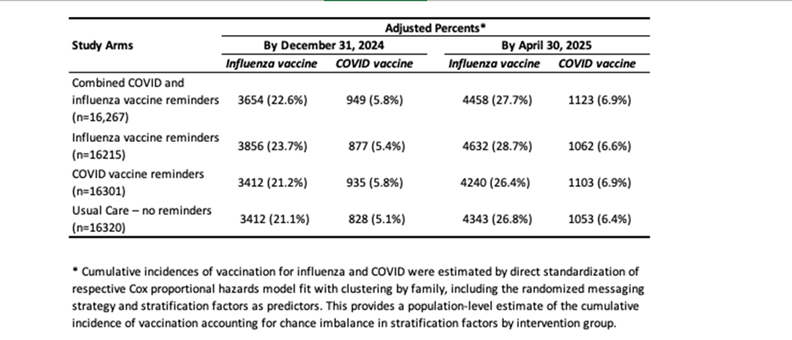
Results: In this NIH-funded trial, 65,103 6 month-17-year-old children were due for both COVID and influenza vaccine (Table 1). The cumulative incidence of COVID vaccination by Dec 31, 2024, was low (<6%) in all arms. Influenza vaccination by Dec 31 was moderately higher (21.1-23.7% in each arm). Influenza-only messages increased influenza vaccination vs usual care (+2.5% [97.5% CI 1.2%, 3.8%]). COVID-only messages had smaller effects on COVID vaccination that were not statistically significant, accounting for multiple comparisons (+0.7% (-0.01%, 1.4%). Combined vs COVID-only messages led to similar COVID vaccination (+0.0% (-0.7%, 0.7%). Combined vs influenza-only messages led to lower, but not significantly lower, influenza vaccination (-1.1% (-2.4%, 0.2%). While additional vaccinations occurred by end of season (Apr 30) most occurred by Dec 31, and differences between messaging strategies decreased. Results did not vary by patient age.
Conclusion: In 2024-25, COVID and influenza vaccination was low. Even in a year with low uptake, text message vaccine reminders increased influenza vaccination but had less impact on COVID vaccine. Combined reminders for both vaccines had a small not statistically significant negative impact on influenza vaccination and no benefit on COVID vaccination.
Table 1. Characteristics of Study Population, 2024-2025
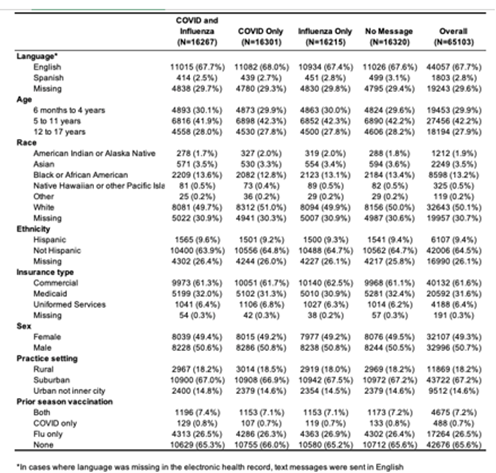
Table 2. Impact of Messaging Strategies on COVID and Influenza Vaccination Based on Standardized Cox Model
Last Updated
05/05/2026
Source
American Academy of Pediatrics